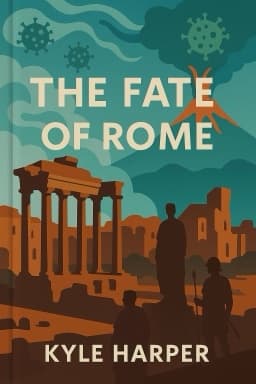
Kyle Harper
A revelatory history of how climate change and pandemics shaped the rise and fall of the Roman Empire.
The Roman Empire's population may have reached 75 million at its peak—about a quarter of the world's population at the time.
Section 1
8 Sections
Imagine standing at the heart of ancient Rome, surrounded by the hum of a million souls, the grandeur of marble temples, and the relentless pulse of a city that never seemed to sleep. It’s easy to believe that the fate of such a civilization rested solely in the hands of its leaders, its generals, and its armies. But what if I told you that the true architects of Rome’s destiny were often unseen—the shifting climate, the invisible pathogens, the very forces of nature themselves?
For centuries, the story of Rome was told as a tale of ambition, conquest, and political intrigue. Yet, beneath the surface, nature was quietly at work, shaping the fortunes of the empire in ways few could have imagined. The city of Rome, at its peak, was a marvel of the ancient world—home to over a million people, a scale of urban life not seen again in the West until the dawn of the modern era. Its streets bustled with commerce, its aqueducts brought fresh water from distant hills, and its citizens enjoyed a level of sophistication that seemed to promise endless prosperity.
But this prosperity was fragile. The empire was a living organism, dependent on the bounty of the land, the rhythms of the seasons, and the health of its people. When the climate was kind—when rains nourished the fields and the sun shone gently—the empire flourished. Yet, when nature turned, the consequences were profound.
Throughout its history, Rome faced not just political and military challenges, but also a series of devastating pandemics. The Antonine Plague swept through the empire, claiming millions of lives and shaking the foundations of society. Later, the Plague of Cyprian and the infamous Justinianic Plague would return, each time leaving a trail of mortality and fear. These were not isolated tragedies, but part of a larger pattern—a pattern woven by the threads of climate, disease, and human ambition.
As we begin this journey through the fate of Rome, let us remember that history is not just the story of great men and women, but also of the unseen forces that shape our world.
What new perspective does the book offer on Rome’s history?
15 more quizzes available in app
Nature’s forces were not passive but actively shaped Rome’s destiny.
7 more insights available in app
Unlock all 8 sections, 8 insights, full audio, and interactive mind map in the SnapBooks app.
How Climate and Disease Decided the Fate of the World’s Greatest Empire—and Why It Matters Now
Read articleHow Deadly Diseases Changed the Course of History—And What We Can Learn
Read article