
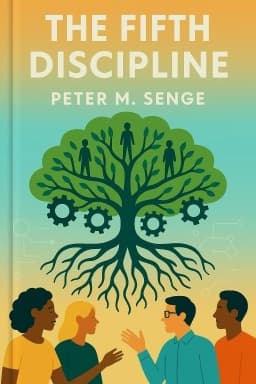
Unlocking the Hidden Power of Learning Organizations: How 'The Fifth Discipline' Can Revolutionize Your Business
Discover the transformative principles behind the world's most adaptive and innovative organizations.

Imagine an organization where every individual is not just a cog in the machine but an active learner, constantly growing and innovating. This is the promise of learning organizations, a concept popularized by Peter Senge in his seminal work, The Fifth Discipline. At its core, the book challenges traditional fragmented approaches to problem-solving and management, urging us to see organizations as interconnected systems where the whole is greater than the sum of its parts.
One of the foundational insights is the danger of fragmentation. When we break problems into isolated pieces, we lose sight of the systemic consequences. This leads to repeated mistakes and unintended side effects. Senge argues that the key to overcoming these challenges is developing organizations that learn collectively — where people expand their capacity to create the results they truly desire.
Central to this transformation is systems thinking, the discipline of seeing wholes. Unlike conventional linear thinking, systems thinking helps us understand feedback loops, delays, and non-obvious leverage points that drive organizational behavior. For example, the famous 'beer game' simulation illustrates how supply chain fluctuations arise not from individual errors but from the structure of the system itself, highlighting the need to address root causes rather than symptoms.
Another critical discipline is personal mastery, which emphasizes lifelong learning and clarity of personal vision. Individuals who commit to personal growth become catalysts for organizational change. However, many adults lose this passion over time, making it vital for organizations to nurture environments that support continuous development.
Mental models represent the deeply ingrained assumptions that shape how we perceive the world. These unconscious beliefs often limit creativity and learning. By surfacing and challenging mental models, teams can break free from limiting patterns and open new possibilities.
Shared vision binds people together around a common purpose, igniting intrinsic motivation. Unlike superficial vision statements, genuine shared vision inspires commitment and resilience, enabling organizations to navigate complexity with a unified focus.
Finally, team learning harnesses collective intelligence through dialogue and inquiry. Effective teams suspend assumptions, listen deeply, and co-create solutions that surpass individual capabilities. This discipline is where the other four converge, producing generative learning that drives sustained success.
In summary, The Fifth Discipline offers a holistic framework for transforming organizations into vibrant learning communities. By embracing systems thinking and the five disciplines, leaders can cultivate adaptability, innovation, and shared purpose. This journey requires patience, courage, and a willingness to see beyond the obvious, but the rewards are profound—a resilient organization capable of moving the world with a lever long enough.
Are you ready to unlock the hidden power within your organization? The path begins with learning to see the whole.
Want to explore more insights from this book?
Read the full book summary