
The Four Horsemen of Leveling: How War, Plagues, and Revolutions Shaped Wealth
Unpacking the brutal forces that have repeatedly reset the scales of wealth and power across civilizations.

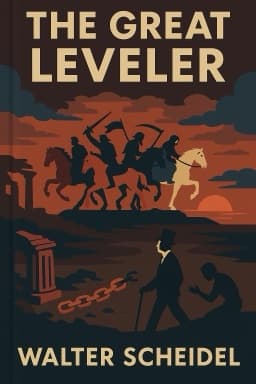
Violence is often seen as a tragic aberration in history, but according to Walter Scheidel’s The Great Leveler, it has been the primary engine driving large-scale reductions in inequality. Scheidel identifies four catastrophic forces—the Four Horsemen of Leveling—that have repeatedly compressed the wealth gap: mass mobilization warfare, transformative revolutions, state collapse, and pandemics.
Mass mobilization warfare, such as the World Wars, mobilized entire populations and economies. The destruction of capital, inflation, confiscatory taxation, and post-war social reforms combined to wipe out vast fortunes and compress income disparities. The Great Compression of the mid-20th century stands as a testament to this leveling power.
Revolutions, whether violent or transformative, dismantled entrenched elites and redistributed land and wealth. The French and Russian revolutions dramatically altered social hierarchies, though often accompanied by repression and turmoil. These upheavals created new social orders with less concentrated wealth.
State collapse, when governments lose control and infrastructure breaks down, disrupts elite privileges. The fall of empires and modern failed states reveal how power vacuums can reset social and economic structures, often violently but with leveling effects.
Pandemics like the Black Death killed large proportions of populations, creating labor shortages that raised wages and reduced rents. This biological shock improved living standards for many and narrowed the income gap between workers and landlords.
These forces share a brutal logic: they destroy accumulated wealth and power, forcibly redistributing resources. Peaceful reforms, by contrast, have rarely matched this scale of impact. This sobering insight challenges modern hopes for gradual, peaceful equality and highlights the human cost behind historical compressions.
Understanding the Four Horsemen helps contextualize current inequality trends and the absence of such leveling shocks today. It raises difficult questions about how to address disparities in a world where violent upheavals are less likely and peaceful mechanisms face structural limits.
This perspective invites us to rethink inequality not just as an economic or political problem but as a phenomenon deeply intertwined with the cycles of violence and catastrophe in human history.
For those interested in the intersection of history, economics, and social justice, this framework provides a powerful lens to understand why inequality persists and how it might be addressed.
Further insights can be found in detailed reviews and discussions from academic and literary sources such as the London School of Economics and Goodreads. 1 3
Want to explore more insights from this book?
Read the full book summary