
Democracy’s Dirty Secret: How Voter Biases Hijack Policy and What You Can Do About It
Exploring the impact of systematic biases on democratic policy-making and steps toward reform

Democracy promises that the collective wisdom of voters will lead to sound policies, but reality paints a different picture. Systematic biases deeply influence voter beliefs, skewing policy preferences and leading to governance that often contradicts expert advice and economic logic.
Among the most pervasive biases is antimarket bias, where voters view profit motives and markets with suspicion, seeing them as sources of greed rather than engines of prosperity. This leads to widespread support for heavy regulation and skepticism toward business, despite evidence that markets generally enhance social welfare.
Antiforeign bias fuels fears about immigration and trade, with voters perceiving these as threats to jobs and national wealth. This zero-sum thinking ignores the economic principle of comparative advantage and mutual gains from trade.
Make-work bias causes voters to prioritize employment quantity over productivity, resisting labor-saving technologies even when they increase overall living standards. Finally, pessimistic bias colors public perception with an overly negative view of economic conditions, fostering nostalgia for an idealized past and resistance to reform.
These biases are not random but systematic, shaping voter preferences and electoral outcomes. Politicians respond by crafting policies that cater to these biases, while media outlets often reinforce them by focusing on entertainment and audience preferences rather than factual reporting. Special interest groups exploit voter ignorance and indifference to push narrow agendas.
Surveys comparing economists and the public reveal large gaps in understanding, with experts holding more accurate views on trade, taxation, and government spending. Even when controlling for ideology and income, these knowledge gaps persist, underscoring the role of education and information in shaping democratic outcomes.
Understanding these dynamics is crucial for reform. Efforts to improve civic education, promote media literacy, and design institutions that mitigate bias can help align democratic policies more closely with expert knowledge and societal welfare.
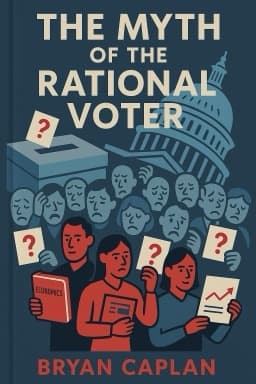
This blog integrates insights from behavioral economics, public choice theory, and political economy, inspired by Bryan Caplan’s "The Myth of the Rational Voter" and subsequent research.
References: 1 , 2 , 3
Want to explore more insights from this book?
Read the full book summary