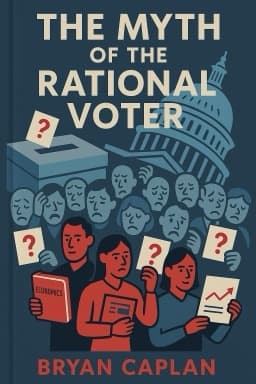
Bryan Caplan
A critical examination of voter irrationality and its role in why democracies often select flawed policies.
Bryan Caplan's book challenges the assumption that voters act rationally, a foundational premise in many political theories.
2 more facts available in the app
Section 1
10 Sections
Imagine a bustling town square where citizens gather to decide their future. The ideal of democracy is that these people, armed with reason and knowledge, will choose the best path forward. Yet,
Consider the enduring example of protectionism. Economists have long agreed that free trade benefits all parties involved, yet nearly every democracy maintains tariffs and import restrictions.
The answer lies in the concept of rational ignorance. Because the chance that a single vote will sway an election is minuscule, it is entirely rational for voters to avoid the cost of acquiring detailed political knowledge.
Yet, this is not a fatal flaw of democracy but a complex challenge. The system's promise remains compelling, but understanding its limitations is crucial. As we move forward, we will explore how systematic biases in voter beliefs shape policy, how economists and the public differ in understanding, and what this means for the future of democratic governance.
Next, we delve into the nature of these biases and how they distort voter perceptions.
What is the central paradox of democracy discussed?
19 more quizzes available in app
Democracy promises rule by the informed majority but often results in policies reflecting voter misconceptions.
8 more insights available in app
Unlock all 10 sections, 9 insights, full audio, and interactive mind map in the SnapBooks app.
Unveiling the paradoxes and biases that shape voter behavior and democratic outcomes
Read articleExploring the impact of systematic biases on democratic policy-making and steps toward reform
Read article
Yanis Varoufakis
Erik Olin Wright
Joseph A. Schumpeter

Kurt Andersen
