
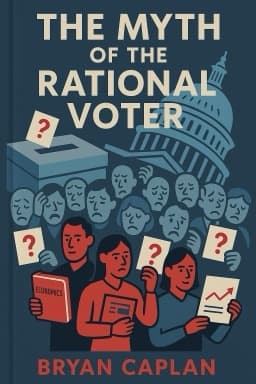
Why Your Vote Might Not Be as Rational as You Think: The Hidden Truths of Democracy
Unveiling the paradoxes and biases that shape voter behavior and democratic outcomes

Democracy is often hailed as the epitome of rational governance, where the collective wisdom of informed voters guides policy decisions. But what if this ideal is more myth than reality? Voter behavior frequently deviates from rationality, influenced by biases and emotional preferences that challenge the foundations of democratic theory.
One of the key insights from public choice theory is the concept of rational ignorance. Since the probability that a single vote will sway an election is minuscule, voters rationally choose not to invest time and effort in acquiring detailed political knowledge. This leads to widespread voter apathy and ignorance, which classical theories assume results in random errors that cancel out in aggregate. However, empirical evidence reveals these errors are systematic and driven by deep-seated biases.
Enter the notion of rational irrationality. Unlike ignorance, rational irrationality suggests that voters deliberately hold biased or false beliefs because these beliefs provide psychological comfort or affirm their identity. Since the personal cost of holding erroneous beliefs is low, voters indulge in misconceptions without fearing consequences. This phenomenon helps explain persistent voter support for economically suboptimal policies such as protectionism and excessive labor market regulation.
The divide between expert economists and the general public is stark. Surveys like the Survey of Americans and Economists on the Economy (SAEE) demonstrate that experts overwhelmingly support free trade and market efficiency, while the public tends to favor protectionist and interventionist policies. These gaps persist even after controlling for political ideology and income, highlighting knowledge as a critical factor.
Politicians and special interest groups respond strategically to these voter biases. Politicians cater to popular misconceptions to secure votes, while interest groups exploit voter indifference on complex issues to advance narrow agendas. Media outlets often reinforce biases by catering to audience preferences rather than challenging them with factual reporting.
Understanding these dynamics is essential for anyone interested in the health and future of democracy. While democracy is imperfect, acknowledging its flaws opens pathways for reform and improvement. By fostering better education, institutional design, and a balanced relationship between markets and democratic governance, society can navigate the challenges posed by voter irrationality.
This blog draws extensively on Bryan Caplan’s groundbreaking book "The Myth of the Rational Voter" and contemporary political economy research, providing a comprehensive view of the complexities underlying democratic decision-making.
For a deeper dive into these ideas, consider reading the original works and surveys that have shaped this field.
References: 1 , 2 , 3 , 4
Want to explore more insights from this book?
Read the full book summary