
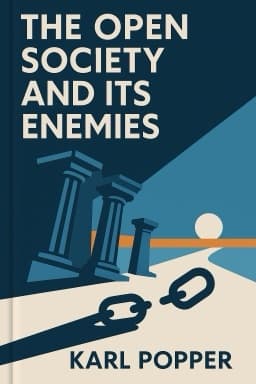
Unmasking Plato’s Dark Legacy: How ‘The Open Society and Its Enemies’ Reveals the Hidden Dangers of Historicism
Discover why Karl Popper warns us against historicism and the authoritarian shadows lurking in Plato’s ideal state.

Karl Popper’s The Open Society and Its Enemies is more than a philosophical treatise; it is a clarion call to defend freedom against the seductive but dangerous allure of historicism. Historicism, the idea that history follows predetermined laws or destinies, has its roots in ancient philosophy, notably in Plato’s vision of eternal Forms and a perfect, unchanging state. But Popper exposes how this belief can justify authoritarianism and suppress individual liberty.
At the heart of Plato’s philosophy lies the Theory of Forms — perfect, eternal realities that physical objects only imperfectly imitate. Plato’s ideal state mirrors this metaphysical perfection: a rigid hierarchy where each class performs its assigned role, and rulers govern with absolute authority. Justice, in this schema, is not equality but social order maintained by obedience and suppression of dissent. Such a vision, Popper argues, is the intellectual foundation of totalitarianism.
Popper’s critique extends to the confusion between natural laws — immutable facts of the universe — and normative laws, which are human-made rules subject to change. Historicism’s failure to distinguish these leads to dogmatic political ideologies that claim historical inevitability, stifling critical debate and reform.
Moreover, Popper reveals how Plato’s political sociology anticipates modern theories of class struggle, emphasizing that revolutions often arise from internal disunity among rulers driven by ambition and economic interests. This dynamic undermines the myth of a perfect, stable society and highlights the need for open, democratic institutions that can adapt and self-correct.
Ultimately, Popper champions an open society where knowledge and norms are provisional, subject to criticism and improvement. This vision embraces individual freedom, pluralism, and democratic governance — the bulwarks against the enemies of freedom.
This exploration not only deepens our understanding of political philosophy but also serves as a warning against complacency in defending democratic values in our times.
For a detailed analysis and further reading, see sources such as the Complete Review’s comprehensive breakdown of Popper’s work, the Wikipedia overview, and scholarly discussions on JSTOR and political think tanks.
Want to explore more insights from this book?
Read the full book summary