Karl Popper
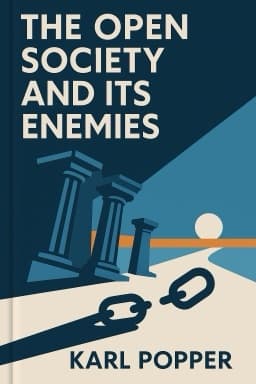
A critical examination of historicism and totalitarianism advocating for an open society based on critical rationalism and individual freedom.
Karl Popper wrote 'The Open Society and Its Enemies' during World War II, a time of global totalitarian threats.
2 more facts available in the app
Section 1
8 Sections
Imagine standing before a vast tapestry woven with the threads of human history, each thread seemingly following a grand design, a predetermined pattern that no one can escape. This is the illusion historicism casts upon us — the belief that history marches forward under the guidance of immutable laws or divine destiny.
As we traverse through this belief, we encounter its modern counterparts: racialism, which posits biological superiority as the driver of history, and Marxian historicism, which views history as the inevitable struggle of classes culminating in a classless society. These frameworks, while differing in details, share the core idea that history is governed by laws that can be discovered and used to predict the future.
Yet, beneath the allure of such certainty lies a profound problem.
In this light, historicism appears less as a scientific theory and more as a myth — a story we tell ourselves to impose order on chaos. But myths, however comforting, can imprison us if we mistake them for reality.
As we prepare to delve deeper, we will explore how early philosophers grappled with change and stability, laying the groundwork for these historicist ideas and their critiques. The journey ahead reveals the tension between flux and permanence that defines human society.
What is the central claim of historicism?
15 more quizzes available in app
Historicism presents history as governed by inevitable laws or destinies, often linked to divine will or natural law.
8 more insights available in app
Unlock all 8 sections, 9 insights, full audio, and interactive mind map in the SnapBooks app.
Discover why Karl Popper warns us against historicism and the authoritarian shadows lurking in Plato’s ideal state.
Read articleExplore how Popper’s warnings about historicism and totalitarianism resonate powerfully in today’s global political climate.
Read article