
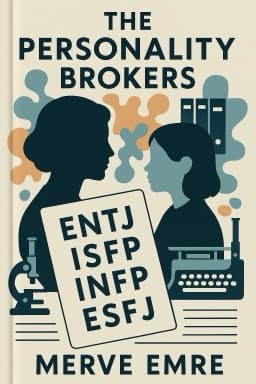
The Secret History Behind the World’s Favorite Personality Test: What ‘The Personality Brokers’ Reveals
How a Mother-Daughter Duo Changed How We See Ourselves—And Why It Matters

How a Mother-Daughter Duo Changed How We See Ourselves—And Why It Matters
Imagine a sun-dappled living room in early 20th-century America, where a determined mother, Katharine Briggs, meticulously observes her daughter, Isabel, in a quest to decode the mysteries of personality. This is not the start of a psychological research paper—it’s the opening scene of Merve Emre’s The Personality Brokers, a book that reads like a detective novel and cultural exposé rolled into one. Emre traces the MBTI’s origins to a family’s domestic experiment, revealing how two women’s curiosity and ambition would eventually shape the way millions understand themselves and each other.
The book uncovers how Katharine and Isabel, working outside the academic mainstream, drew inspiration from Carl Jung’s theories, but also injected their own blend of intuition, discipline, and American optimism. Through years of observation, forced-choice questionnaires, and even fiction writing, they developed the framework that would become the MBTI. What started as a homegrown project soon found its way into schools, corporations, the military, and even churches. The MBTI’s four-letter codes—like ENFP or ISTJ—became a cultural shorthand, promising self-knowledge and better relationships.
But Emre doesn’t shy away from the test’s darker side. She exposes how the MBTI’s popularity outpaced its scientific credibility, noting that most psychologists today question its reliability and validity. Yet, the test’s appeal endures, fueled by its comforting language and the billion-dollar industry that markets it. The MBTI, Emre argues, is both a mirror and a myth—a tool that flatters as much as it classifies, offering hope but also limiting possibilities.
Ultimately, The Personality Brokers is about more than just a test. It’s a story of ambition, family, the search for meaning, and the ways we try to understand ourselves in a bewildering world. Through Emre’s sharp analysis and vivid storytelling, readers are invited to question not just the MBTI, but the very nature of personality—and the lengths we’ll go to define who we are.
References: Slate, NY Times, The New Republic
Want to explore more insights from this book?
Read the full book summary