
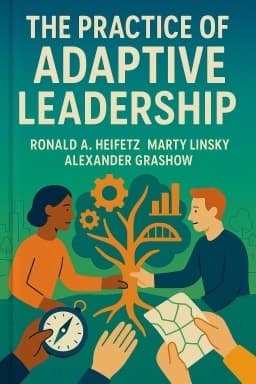
Unlocking the Secret Sauce of Adaptive Leadership: Why Most Leaders Get It Wrong
Discover the Hidden Patterns That Make or Break Modern Leaders

In a world where uncertainty is the only certainty, most leaders find themselves stuck in the quicksand of old solutions. The headlines are full of companies and communities blindsided by change—think Blockbuster’s fall to Netflix, or traditional retailers struggling in the Amazon era. Why do so many smart, experienced leaders falter? The answer lies in understanding the difference between technical and adaptive challenges, a distinction at the heart of adaptive leadership.
Adaptive leadership, as defined by Heifetz, Grashow, and Linsky, is the practice of mobilizing people to tackle tough challenges and thrive. Unlike technical problems—where the solution is known and expertise can be applied—adaptive challenges require new learning, shifts in values, and often, letting go of cherished routines. Most leadership failures occur when adaptive challenges are misdiagnosed as technical problems. This is the secret sauce: knowing when to step back, observe, and experiment rather than rushing to fix.
Consider the story of a global manufacturer facing digital disruption. The leadership team, full of technical experts, launched a series of new products and marketing campaigns. But sales kept slipping. Only when they paused and asked deeper questions—about customer values, internal silos, and the culture of risk aversion—did they start to see the real adaptive work ahead. This shift required mobilizing not just the executive team, but frontline employees, customers, and even partners. Adaptive leadership is about seeing the system, not just the symptoms.
One of the most powerful tools in the adaptive leader’s kit is the ability to move between the 'balcony' and the 'dance floor.' On the balcony, you see the big picture: patterns, relationships, and defaults. On the dance floor, you engage directly, testing interventions and learning in real time. This dual perspective is essential for diagnosing organizational systems. As the saying goes, every system is perfectly designed to get the results it currently gets. If you want different results, you must change the system—not just the people within it.
Adaptive leadership also means orchestrating conflict, not avoiding it. Real change stirs up loss—of status, comfort, or identity. Leaders must create holding environments where people can surface competing values and experiment safely. This is not about winning arguments, but about building adaptive capacity. Think of the countless organizations that tried to implement diversity initiatives without addressing the underlying culture—progress stalls when losses are ignored.
But here’s the twist: adaptive leadership is deeply personal. Leaders must reflect on their own defaults, triggers, and loyalties. Are you avoiding tough conversations because of a desire for harmony? Do you default to fixing problems yourself rather than empowering others? Self-awareness is the foundation of adaptive work. Only by seeing yourself as a system can you hope to lead others through adaptation.
In conclusion, adaptive leadership is the secret sauce for thriving in complexity. It is not a set of tips, but a way of being—curious, experimental, and deeply human. If you want to lead in the modern world, start by asking not, 'What should I do?' but 'What is really going on here?' and 'What needs to change in me for us to thrive?'
Ready to unlock your own adaptive potential? Dive deeper into the book and its practical tools, and join the growing community of leaders who are learning to thrive amid uncertainty. Because the future belongs to those who adapt.
Want to explore more insights from this book?
Read the full book summary