
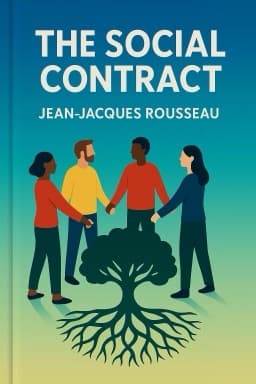
Why Rousseau’s Social Contract Still Rocks Our World: The Secret Blueprint for Modern Freedom
Discover How an 18th-Century Book Still Shapes Democracy and Your Daily Life

Discover How an 18th-Century Book Still Shapes Democracy and Your Daily Life
In a world that often feels divided and chaotic, it’s easy to forget that the principles holding society together were once radical, even dangerous. Jean-Jacques Rousseau’s 'The Social Contract' is one such revolutionary text. Written in 1762, its opening line—'Man is born free, and everywhere he is in chains'—still echoes through courtrooms, protests, and classrooms. But what does it really mean? And why does it matter today?
Rousseau’s genius was to see that freedom isn’t just about doing whatever you want; it’s about living in a community where everyone’s voice counts. He argued that true liberty is possible only when individuals come together to create a 'general will,' a collective agreement about what’s best for all. This idea shattered old notions of monarchy and divine right, paving the way for modern democracy.
But Rousseau didn’t stop at theory. He showed how the social contract works in practice: by giving up some personal freedoms, we gain civil liberty and moral freedom—the ability to obey laws we help create. This isn’t just abstract philosophy; it’s the basis of constitutions, voting rights, and public debate. Think of how towns come together to pass local ordinances, or how movements like civil rights and climate activism mobilize people around a shared cause. These are modern echoes of Rousseau’s vision.
Yet Rousseau also warned of dangers. When people become apathetic, when laws serve only the powerful, or when leaders ignore the general will, societies unravel. His call for periodic assemblies and civic renewal is a wake-up call for our own era, marked by polarization and declining trust in institutions.
What makes Rousseau’s Social Contract so enduring is its optimism. It insists that change is possible, that ordinary people can shape their own destinies, and that freedom is a shared project. Whether you’re reading about the American Revolution, the French Republic, or today’s struggles for justice, Rousseau’s ideas are there, challenging us to build a more just and equal world. If you’ve ever wondered why democracy matters or how real change happens, look no further than Rousseau’s blueprint for freedom. 1 2 3
Want to explore more insights from this book?
Read the full book summary