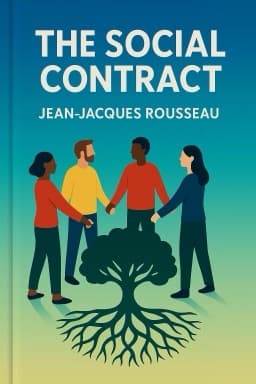
Jean-Jacques Rousseau
A seminal work on political legitimacy, freedom, and the foundations of democratic society.
Rousseau’s ideas in The Social Contract inspired both the French and American revolutions.
Section 1
6 Sections
Let us begin our journey into the wisdom of The Social Contract by pausing to reflect on a paradox that touches every human life: we are born free, yet everywhere we are in chains. This opening idea is not a lament, but an invitation to look deeply at the nature of our existence. Imagine a child, full of curiosity, running barefoot through the grass—untamed, unburdened, and alive with possibility. Now, picture the same child years later, shaped by rules, customs, and invisible expectations.
Rousseau’s insight is gentle yet profound. The chains we wear are not always forged by force or violence. They are woven from habits, traditions, and the silent agreements we inherit from those before us. Our first society is the family, where authority is natural and loving. But as we grow, we step out into a world of hierarchies and institutions. Here, the chains tighten. Yet, Rousseau reminds us, these chains are not inevitable. They are made by people—and what is made can be remade.
He tells us that every society, no matter how ancient, began with a choice. The family, for example, only remains a society as long as the children need their parents. Once they are grown, the bond is voluntary. This is the first lesson:
Throughout history, people have tried to explain why some should rule and others obey. Some said it was because of strength, others because of tradition. Rousseau gently pulls back the curtain, showing that true freedom comes only when we agree to the rules together, as equals. He uses the metaphor of the family to show that just as children grow and question their parents, so too must citizens question their rulers.
As we move forward, let us remember this: freedom is not lost, but transformed. The journey from the wild to the civilized is not a fall from grace, but a step towards a new kind of liberty. The chains that bind us can also unite us, if we choose them wisely. And so, let us walk together into the next section, where we will discover how a group of free individuals can come together to form something greater than themselves—the social contract.
What does Rousseau mean by 'chains' in the famous opening line?
11 more quizzes available in app
Humans are born free but quickly find themselves constrained by society.
7 more insights available in app
Unlock all 6 sections, 8 insights, full audio, and interactive mind map in the SnapBooks app.
Discover How an 18th-Century Book Still Shapes Democracy and Your Daily Life
Read articleWhat Rousseau Can Teach Us About Saving Democracy from Ourselves
Read article
F. A. Hayek
Niccolò Machiavelli
Daniel Chandler
Jonah Goldberg
