
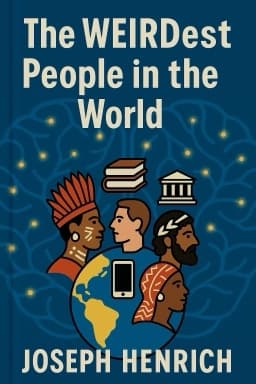
Why Are WEIRD People So Different? The Shocking Truth About Western Minds
Unpacking the psychological uniqueness of Western societies and how it reshaped the modern world.

When psychologists first began studying human behavior, the assumption was that findings from Western populations would generalize globally. However, a startling discovery emerged:
Imagine a world where your identity is less about your family or tribe and more about your personal traits and achievements. In WEIRD societies, people answer “Who am I?” with descriptions like 'curious' or 'independent,' rather than relational roles such as 'daughter' or 'brother.' This shift is profound, influencing motivation, cognition, and social interactions.
Moreover, emotional regulation differs: WEIRD people experience guilt, an internalized self-judgment, while many other societies emphasize shame, a social emotion tied to public perception. This difference alters how people behave and relate to others.
Trust is another hallmark. WEIRD populations tend to trust strangers and cooperate based on abstract rules rather than kinship ties, enabling complex, large-scale institutions like markets and democracies to function.
These psychological peculiarities are not random but evolved culturally through historical processes unique to Western societies. Understanding these distinctions helps explain global psychological diversity and challenges assumptions about human nature.
As we explore further, we will see how cultural evolution, kinship changes, and economic systems shaped these psychological traits, leading to the modern world’s unique institutions and innovations.
Sources: [[0]](#__0), [[1]](#__1), [[3]](#__3)
Want to explore more insights from this book?
Read the full book summary