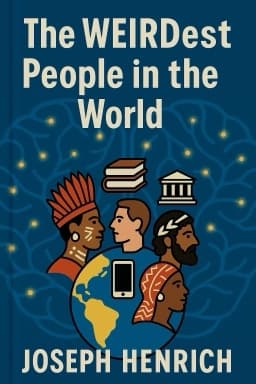
Joseph Henrich
An interdisciplinary exploration of how unique cultural and institutional evolutions shaped the distinct psychology of Western societies and the modern world.
The term WEIRD stands for Western, Educated, Industrialized, Rich, and Democratic.
Section 1
8 Sections
Imagine a world where your sense of self is not just a reflection of your family, community, or tribe, but a deeply personal, consistent identity that you carry across all aspects of your life. This is the world of WEIRD people—Western, Educated, Industrialized, Rich, and Democratic populations—whose psychology stands out strikingly from much of humanity.
In contrast, many traditional societies, such as the Maasai and Samburu tribes, root identity in social roles and kinship, where people define themselves primarily through their relationships and communal obligations. This difference is not just semantic but reflects a profound psychological divergence that shapes motivations, emotions, and social interactions.
Another key distinction lies in emotional regulation: WEIRD societies are guilt-ridden, where individuals internalize personal standards and feel guilt when they fall short.
This psychological orientation extends to trust and cooperation. WEIRD people tend to trust strangers more and cooperate based on impartial rules rather than kinship ties. Experiments with diplomats at the United Nations showed that delegations from less corrupt, more WEIRD-like countries accumulated fewer parking tickets, suggesting ingrained norms of impersonal honesty. Similarly, in anonymous dice-rolling games, participants from WEIRD societies were more likely to follow impartial rules, even when cheating could benefit their family, highlighting a remarkable commitment to abstract principles over relational loyalty.
These psychological peculiarities are not trivial quirks but foundational traits that enable the functioning of large-scale, impersonal institutions such as markets, legal systems, and democratic governments.
Let us now turn to the origins of these psychological differences by understanding what it means to be a cultural species and how our brains have been rewired by culture itself.
What does the acronym WEIRD represent?
15 more quizzes available in app
WEIRD people focus on personal attributes and consistency across relationships, unlike many societies that emphasize social roles.
8 more insights available in app
Unlock all 8 sections, 9 insights, full audio, and interactive mind map in the SnapBooks app.
Unpacking the psychological uniqueness of Western societies and how it reshaped the modern world.
Read articleDiscover the astonishing ways culture shapes our brain, behavior, and societies over generations.
Read article
Bryan Stevenson
Katherine Zoepf
Robert Whitaker
Jesse Singal
