
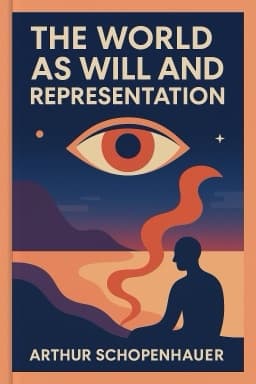
Unlocking the Hidden Reality: How Schopenhauer’s Philosophy Reveals the World as Your Own Mind’s Creation
Discover how your mind shapes reality and why the world you see is inseparable from your perception.

Have you ever stopped to wonder if the world around you exists independently of your perception? What if the landscape you admire, the people you meet, and even the stars above are not separate realities but intimate creations of your own mind? This might sound like the premise of a surreal novel, but it is the profound insight of Arthur Schopenhauer’s philosophy.
The world as representation is the cornerstone of his thought. According to Schopenhauer, what we call 'reality' is always mediated through our senses and cognitive faculties. The raw world-in-itself remains forever inaccessible; instead, we engage with a world shaped by the forms of our intuition — space and time — and structured by the principle of sufficient reason.
Imagine wearing colored glasses that tint everything you see. The colors, shapes, and distances are not properties of objects themselves but the way your mind organizes sensory data. Space and time are not external containers but mental frameworks imposed on experience. This means that the world you perceive is inseparable from you, the perceiving subject.
This insight is not merely abstract philosophy but resonates with modern cognitive science, which shows that perception is an active construction by the brain rather than passive reception. Neuroscientific studies reveal how sensory inputs are processed and interpreted, confirming the mind’s central role in shaping reality.
Moreover, the principle of sufficient reason — the idea that everything must have a cause or reason — governs how we understand changes and relations in the world. When you see an apple falling, you don’t just see motion; you grasp the invisible force of gravity as its cause. This causal understanding is embedded in the structure of cognition itself.
Schopenhauer’s vision invites us to reconsider our relationship with the world. Instead of a detached observer, you become an integral participant in the creation of experience. This shift opens doors to deeper self-awareness and philosophical inquiry, challenging assumptions about objectivity and the nature of existence.
As we continue exploring Schopenhauer’s philosophy, we will journey beyond representation to uncover the hidden metaphysical force — the will — that animates all phenomena. This next step will deepen our understanding of desire, suffering, and ultimately, freedom.
Sources: Stanford Encyclopedia of Philosophy on Schopenhauer’s metaphysics and aesthetics 1 , 3 ; Internet Encyclopedia of Philosophy on perception and causality 2 .
Want to explore more insights from this book?
Read the full book summary