
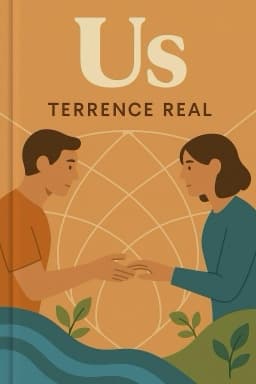
Unlocking the Secret to Lasting Love: How ‘Us’ Transforms Relationships Forever
Discover the revolutionary approach that breaks toxic patterns and builds deep, lasting connection.

In a world that often celebrates rugged individualism and self-reliance, Terrence Real’s book ‘Us’ offers a radical invitation: to move beyond the myth of the independent self and embrace the transformative power of connection. This journey begins by recognizing the internal voices within us — the Adaptive Child, shaped by trauma and survival, and the Wise Adult, capable of compassion and presence.
The Adaptive Child is not an enemy but a protector formed in response to childhood wounds. It drives many of our reactive behaviors in relationships — harshness, withdrawal, or control — yet harshness itself is a destructive force that alienates rather than heals. Real shares powerful stories of individuals who, upon realizing the harm caused by harshness, wept and embraced a new path of loving firmness. This shift is the foundation of healing.
Neuroscience supports this relational approach. Our brains are wired for connection, not isolation. Social Baseline Theory reveals that when we are with trusted others, our brain’s energy-demanding centers relax because we share the burden of emotional regulation. Conversely, isolation, such as solitary confinement, leads to severe mental deterioration. This biological truth challenges cultural myths of rugged independence and calls us to prioritize relationships as essential nutrients for survival.
Trauma often hijacks our ability to connect, creating adversarial 'you and me' dynamics instead of cooperative 'us' consciousness. Real explains how relational trauma — subtle, repetitive, and relational wounds — shape the Adaptive Child and influence adult relationships. These patterns, often unconscious, fuel cycles of conflict and disconnection.
Moreover, cultural myths of individualism — rugged and Romantic — complicate our identities. Rugged individualism prizes autonomy and control, while Romantic individualism emphasizes authentic self-expression. Both can cause tension within families when they overshadow the need for connection and compromise.
But there is hope. Real advocates for minute-to-minute relational mindfulness, a practice of observing impulses and choosing connection over reactivity. This ongoing work builds trust and intimacy, moving couples from adversarial patterns toward teamwork and mutual respect.
Real also challenges us to let go of idealized fantasies about relationships. True love grows not in perfection but in the messy embrace of vulnerability and acceptance. Fierce intimacy combines assertive honesty with soft empathy, balancing strength and tenderness to foster deep connection.
Healing extends beyond the couple to the family lineage. Generational trauma passes unhealed wounds from parents to children, but conscious healing and relational mindfulness can break these cycles, offering a better legacy for future generations.
Ultimately, becoming whole is a lifelong journey of integration and relational growth. Choosing connection over isolation transforms lives, creating resilience, joy, and lasting love.
Terrence Real’s ‘Us’ is more than a book; it is a call to courage, presence, and grace — an invitation to choose connection every moment and build the loving relationships we all long for.
Want to explore more insights from this book?
Read the full book summary