
Unlocking the Secrets of Trust: Why We Believe and How It Shapes Our World
Discover the invisible force that connects us all and drives innovation, relationships, and society forward.

Imagine a world without trust — where every handshake is met with suspicion, every transaction questioned, and every relationship fraught with doubt. Trust is often invisible, yet it is the foundation of human society. It is the confident relationship with the unknown that allows us to take risks, collaborate, and innovate.
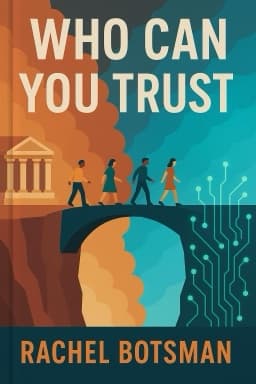
Rachel Botsman’s exploration into trust reveals its multifaceted nature and evolution. Trust is not static; it is dynamic and contextual, shaped by our interactions, culture, and technology. At its core, trust bridges the gap between what we know and what we must accept without guarantees. This bridge enables vulnerability and connection.
Historically, trust leaps—moments when society collectively embraces new ways of trusting—have propelled humanity forward. The transition from bartering goods to using paper money exemplifies such a leap, requiring confidence in abstract value and institutions. Similarly, the rise of long-distance trade relied on reputation systems and social networks to extend trust beyond immediate circles.
Yet, today, trust in traditional institutions like banks, governments, and media is waning. Scandals, inequality of accountability, and the spread of misinformation have fueled a crisis. For example, the 2008 financial collapse eroded faith in banks, while the Panama Papers leak exposed global corruption. This erosion challenges the social contract and invites a search for new trust models.
Enter the digital age, where trust is being rebuilt in novel ways. The 'trust stack' concept shows how trust develops in layers—from accepting new ideas to trusting platforms and finally trusting individuals. The California Roll Principle demonstrates how familiar elements help us embrace the unfamiliar, easing adoption of innovations like ride-sharing and home-sharing platforms.
Accountability remains a central challenge. Incidents like violent crimes by gig economy workers highlight gaps in responsibility. Meanwhile, executives often escape consequences with golden parachutes, deepening public cynicism. Integrity and transparency become essential values for maintaining trust in this distributed landscape.
Reputation systems and ratings emerge as powerful tools, enabling trust among strangers even in unexpected places like darknet markets. These systems provide social proof and incentivize good behavior, but also raise concerns about fairness and privacy.
The rise of artificial intelligence introduces new dimensions to trust. People increasingly rely on AI for critical decisions, yet ethical oversight lags behind. Balancing automation with human values is vital to ensuring trustworthy AI.
Blockchain technology offers a revolutionary architecture for trust—decentralized, transparent, and immutable. However, events like the DAO hack reveal tensions between code-based trust and human judgment, underscoring the complexity of this new frontier.
Ultimately, we are witnessing a trust revolution. Power and influence are shifting from institutions to individuals and networks, reshaping society and work. Understanding and embracing these changes with ethical commitment can lead to a more connected and resilient future.
Trust is not lost; it is transforming. By learning how to build, repair, and sustain trust, we can navigate uncertainty with confidence and hope.
Want to explore more insights from this book?
Read the full book summary