
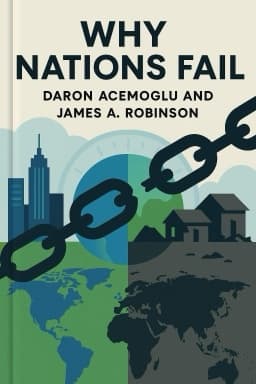
Why Nations Fail? The Shocking Truth About Borders, Power, and Prosperity
Unraveling the Real Reasons Behind Global Wealth Disparities and How Institutions Shape Our World

Unraveling the Real Reasons Behind Global Wealth Disparities and How Institutions Shape Our World
Imagine standing on a fence that divides two cities with the same culture, climate, and history. On one side, children attend well-equipped schools, roads are paved, and businesses flourish. On the other, poverty is widespread, infrastructure crumbles, and opportunities are scarce. This is not a fantasy but the reality of Nogales, split between Arizona and Sonora. The stark contrast is not due to geography or culture but institutions—the rules, laws, and political systems that govern society.
For centuries, scholars attributed economic disparities to geographic luck or cultural differences. However, history challenges these notions. Tropical regions once hosted prosperous civilizations like the Aztecs and Incas, while temperate zones were less developed. Moreover, culture often evolves from institutional contexts rather than causing economic outcomes. Trust, social norms, and work ethic reflect the political and economic environment.
But knowledge alone does not guarantee success. Many poor countries have access to sound economic advice yet fail to implement effective policies. The reason? Political incentives. Leaders often prioritize maintaining power over adopting reforms that benefit the majority. Ghana’s industrial projects in the 20th century, for example, were politically motivated rather than economically viable, illustrating how political interests shape economic outcomes.
At the heart of this dynamic lies the distinction between inclusive and extractive institutions. Inclusive institutions provide secure property rights, unbiased legal systems, and broad participation in markets and politics. Extractive institutions concentrate power and wealth, using coercion and repression to maintain control. Barbados in the 17th century exemplified extractive institutions with a planter elite owning land and enslaved laborers denied economic freedom. In contrast, South Korea’s inclusive economic institutions enabled rapid growth and innovation despite authoritarian politics.
History is shaped by critical junctures—pivotal moments like the Black Death or the Glorious Revolution—that disrupt institutional paths. These events, combined with institutional drift, explain why similar societies diverge dramatically over time. The Industrial Revolution itself was not just about technology but the institutional environment that fostered innovation and investment.
Yet, powerful elites often resist reforms that threaten their privileges, creating barriers to development. Colonial legacies further entrenched extractive institutions through forced labor systems like encomiendas and mitas, leaving scars that persist today. However, some nations like Botswana and South Korea have broken free by transforming institutions through political will, broad coalitions, and inclusive reforms.
Ultimately, institutions shape the destiny of nations by determining incentives, political power distribution, and economic opportunities. While change is challenging due to vested interests and path dependence, collective action and empowerment offer hope for a more prosperous and inclusive future. Understanding this institutional foundation is essential for anyone seeking to grasp global inequality and development.
As you reflect on these insights, remember:
Want to explore more insights from this book?
Read the full book summary