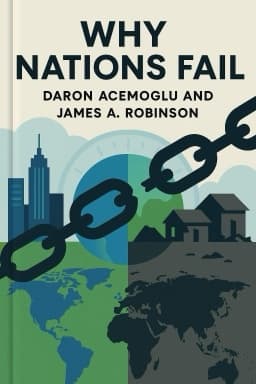
Daron Acemoglu and James A. Robinson
Economic and political institutions, shaped by history and power distribution, determine why some nations prosper while others remain poor.
Why Nations Fail has been translated into over 30 languages.
Section 1
10 Sections
Imagine standing on a fence that divides two halves of what was once a single community. On one side, the city bustles with schools full of eager students, clean roads, reliable electricity, and a government accountable to its citizens. On the other side, just a few feet away, the streets are rough, schools are underfunded, and political corruption looms large. This is the story of Nogales, a city split by the U.S.-Mexico border.
Both sides share the same people, food, and music, yet their daily realities are worlds apart. In Nogales, Arizona, the average household income is about $30,000, while just south of the fence it is roughly a third of that. On the U.S. side, most adults have completed high school, and the government provides essential services like healthcare, law enforcement, and infrastructure. On the Mexican side, many teenagers are out of school, infant mortality rates are higher, and corruption hampers development.
Consider this: germs and diseases do not respect borders, yet health outcomes differ dramatically. The climate is the same, and the cultural ties are strong. What then explains this divide? The answer lies in the institutions—the formal and informal rules that shape economic activity and political power. In the United States, inclusive institutions allow broad participation and protect property rights. In Mexico, extractive institutions concentrate power and wealth in the hands of a few, limiting opportunities for the majority.
Institutions determine whether a society fosters innovation, education, and entrepreneurship or whether it stifles ambition and locks people into poverty. This realization challenges many common explanations for poverty that focus on geography or culture. Instead, it points to the need to understand how political power is distributed and exercised, and how economic institutions emerge from this political landscape.
As we begin this journey, keep in mind that the story of Nogales is not unique. Across the globe, borders often separate prosperity from poverty, not because of natural differences but because of the institutions that lie on either side. Understanding this is the first step toward unraveling why nations succeed or fail.
Let us now delve deeper into the theories that have tried—and failed—to explain these disparities, to see why institutions hold the key.
What primarily explains the prosperity gap between Nogales, Arizona and Nogales, Sonora?
19 more quizzes available in app
Institutions create incentives that shape economic outcomes more than geography or culture.
8 more insights available in app
Unlock all 10 sections, 9 insights, full audio, and interactive mind map in the SnapBooks app.
Unraveling the Real Reasons Behind Global Wealth Disparities and How Institutions Shape Our World
Read articleUnmasking the Hidden Forces That Trap Nations in Poverty and How They Can Be Broken
Read article
Kate Raworth

Roger Bootle

Raghuram Rajan

Nouriel Roubini
