
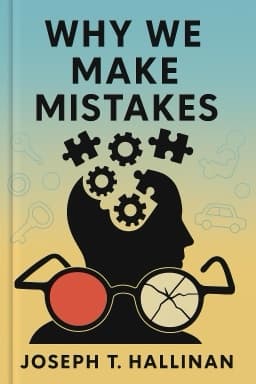
The Surprising Science of Everyday Blunders: What Your Mistakes Reveal About You
How Your Brain’s Design Makes You Fallible—and How to Use That Knowledge to Thrive

How Your Brain’s Design Makes You Fallible—and How to Use That Knowledge to Thrive
Ever left your coffee on top of your car, or searched frantically for your glasses only to find them on your head? You’re not alone. According to Joseph Hallinan’s 'Why We Make Mistakes,' these everyday errors are not random; they’re the natural outcome of a brain optimized for speed, not perfection. The book reveals that our attention is easily hijacked, especially in a world overloaded with information. Multitasking, for example, is largely a myth—your brain can only focus on one complex task at a time, so switching between them leads to mistakes.
Memory quirks are another culprit. We’re wired to remember faces—an evolutionary advantage—but names, which are arbitrary, often slip away. The same goes for passwords, phone numbers, and appointments. Our brains prioritize meaningful information and patterns, which is why you might recall a friend’s story from years ago but forget the details of yesterday’s meeting.
Biases also play a starring role in our mistakes. Anchoring bias means the first piece of information you see—like a price tag or a test answer—can shape all your subsequent judgments. Confirmation bias leads you to notice evidence that supports your beliefs while ignoring what contradicts them. These mental shortcuts help us navigate a complex world, but they also set us up for predictable errors.
Your environment matters, too. Studies show that people recall information better when tested in the same place they learned it—context-dependent memory. Even your mood can affect focus and recall: happiness boosts creativity and memory, while stress narrows your attention.
The good news? Understanding these patterns gives you the power to change them. Use checklists for complex tasks, standardize routines, and create cues in your environment to trigger memory. Most importantly, forgive yourself when you slip up—self-compassion is proven to boost resilience and learning.
Mistakes are not signs of weakness; they’re evidence of a brain doing its best in a messy world. Embrace them, learn from them, and you’ll unlock the secrets to a more mindful, connected, and successful life.
Sources: 1 , 3 , 4
Want to explore more insights from this book?
Read the full book summary