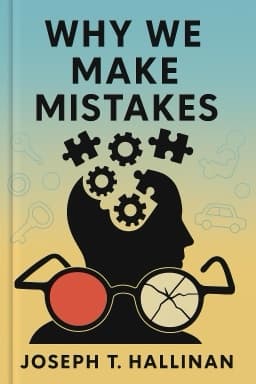
Joseph T. Hallinan
A captivating look at why our brains make predictable mistakes—and what we can do about it.
The book opens with the story of a mob confusing a pediatrician with a pedophile, highlighting how language mistakes can have dramatic real-world consequences.
Section 1
6 Sections
Let us begin our journey into the hidden patterns of human error by embracing a simple truth: our senses, though wondrous, are not perfect recorders of reality. Imagine standing in a bustling city square, your eyes darting from face to face, your mind weaving together a tapestry of impressions. Yet,
Consider the curious phenomenon of change blindness. In studies, a stranger asks for directions, and midway through the conversation, the stranger is swapped for another person. Remarkably, most people do not notice the switch. Our minds, it seems, are so intent on the meaning of the interaction—helping someone, giving directions—that the details of who we are helping slip by unnoticed.
Memory, too, is a delicate vessel. We trust it to hold our passwords, our appointments, the names of those we cherish. Yet, research reveals that a third of us will forget a new password within a week; two-thirds will lose it within three months. Perhaps you have felt that sinking feeling, searching for a word or a name that dances just out of reach. This is not a personal failing, but a shared human experience. Our memories are tuned for meaning, not minutiae. We remember faces for decades, but names fade like morning mist. Our minds are sculpted to recognize what is important—a familiar smile, the comfort of a loved one’s face—while the arbitrary, the unanchored, slips away.
And so, as we begin this journey, let us be gentle with ourselves. To be human is to be imperfect, to overlook, to forget.
Next, let us explore the shortcuts our minds take—the heuristics that help us, and sometimes hinder us, in navigating the world.
What is 'change blindness'?
11 more quizzes available in app
Our senses are not infallible cameras, but interpretative tools.
7 more insights available in app
Unlock all 6 sections, 8 insights, full audio, and interactive mind map in the SnapBooks app.
Unlocking the Hidden Science Behind Everyday Errors and How to Grow From Them
Read articleHow Your Brain’s Design Makes You Fallible—and How to Use That Knowledge to Thrive
Shane O'Mara
Daniel J. Levitin
Michael Pollan
Richard Dawkins
