
From Clutter to Clarity: How Defining Your Writing Goals Transforms Reader Response
Discover why knowing exactly what you want to achieve with your writing is the first step to success.

Have you ever written something only to realize later that your message was muddled or missed the mark? This common frustration often stems from unclear writing goals.
The Power of Purpose
Writing is a tool for thinking. When your goals are fuzzy, your words will be too. Defining clear objectives—what you want your reader to understand or do—focuses your message and guides every word you write.
How Clear Goals Improve Writing
- Focus Content: Eliminate irrelevant information that distracts readers.
- Enhance Clarity: Organize ideas logically to support your purpose.
- Boost Impact: Align your message with what readers need and expect.
- Streamline Revision: Use goals as a checklist to refine and cut.
Practical Steps to Define Your Writing Goals
- Ask yourself: What is the main takeaway or action?
- Write a one-sentence summary of your purpose.
- Review your draft against this summary, cutting anything that doesn’t serve it.
- Proofread carefully to avoid errors that undermine credibility.
By starting with clear goals, you respect your reader’s time and cognitive limits, making your writing more effective and engaging.
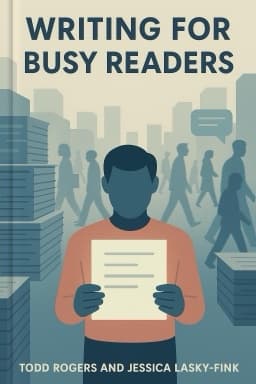
For a comprehensive guide on aligning your writing with reader needs, Todd Rogers’ "Writing for Busy Readers" offers invaluable insights and practical advice.
Sources: Todd Rogers, Writing for Busy Readers; Stanford Graduate School of Business; DM Group Research [[0]](#__0) [[1]](#__1) [[2]](#__2)
Want to explore more insights from this book?
Read the full book summary