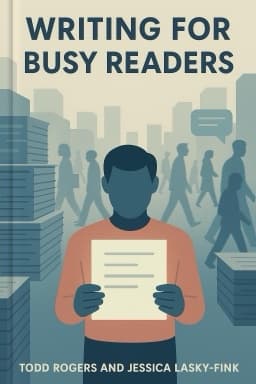
Todd Rogers, PhD, and Jessica Lasky-Fink, PhD
A science-based guide to writing clearly and effectively for busy readers overwhelmed by information.
The phrase 'Less is more' was popularized by Shakespeare's Polonius in Hamlet, emphasizing brevity.
2 more facts available in the app
Section 1
8 Sections
Imagine stepping into the shoes of a busy reader, someone overwhelmed by the relentless tide of emails, texts, and notifications each day.
But this selective focus comes with limits.
Adding to the challenge is the widespread myth of multitasking. While we often believe we can juggle multiple tasks simultaneously, research shows that what we call multitasking is actually rapid task-switching.
Moreover, attention is a resource that depletes quickly. Studies reveal that after even a short period of intense focus—like trying to ignore flashing distractions on a screen—our ability to concentrate on subsequent tasks diminishes significantly. This explains why children need recess and why we often lose focus after hours of work.
For writers, these insights are a call to empathy and strategy. To reach busy readers, we must respect their cognitive limits, crafting messages that stand out, are easy to scan, and require minimal mental effort. As we move forward, the next section will reveal how understanding these reader behaviors guides the art of writing with purpose and clarity.
What is the primary function of selective attention?
15 more quizzes available in app
Busy readers have finite mental resources that constrain how much information they can process at once.
8 more insights available in app
Unlock all 8 sections, 9 insights, full audio, and interactive mind map in the SnapBooks app.
Unlock the secrets to capturing and holding the attention of overwhelmed readers in today’s fast-paced world.
Read articleDiscover research-backed reasons why brevity boosts your email success and how to master the art of the short message.
Read article