
Master the Art of Formatting: How Visual Design Boosts Reader Engagement
Learn how strategic formatting can transform your writing into a reader-friendly experience that commands attention.

Words are only part of the story. How you present those words visually can make or break your reader’s experience. For busy readers, well-designed formatting acts as a roadmap, guiding their eyes and thoughts through your message.
The Role of Formatting in Reading
Readers scan text rapidly, looking for cues to help them decide what to read fully. Headings break content into digestible sections, bullet points highlight key ideas, and bold text draws attention to critical words or phrases.
Formatting Best Practices
- Use Clear, Descriptive Headings: They serve as signposts for navigation.
- Chunk Information: Break text into short paragraphs or bullet points.
- Bold Strategically: Highlight only the most important terms or calls to action.
- Avoid Over-Formatting: Too much bold, underline, or caps-lock creates visual noise and reduces impact.
Over-formatting is like shouting constantly—it tires readers and diminishes the effectiveness of your emphasis. Instead, aim for balance and clarity.
Thoughtful formatting complements concise and simple writing, creating a seamless reading experience that respects your reader’s time and cognitive limits.
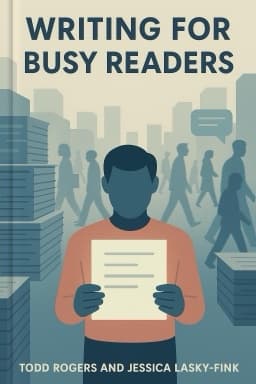
For more on how to combine content and design for maximum impact, Todd Rogers’ "Writing for Busy Readers" provides a research-backed roadmap to writing that resonates.
Sources: Todd Rogers, Writing for Busy Readers; Stanford Graduate School of Business; DM Group Research [[0]](#__0) [[1]](#__1) [[2]](#__2)
Want to explore more insights from this book?
Read the full book summary