
The Surprising Science Behind Why Short Emails Get More Replies
Discover research-backed reasons why brevity boosts your email success and how to master the art of the short message.

Every professional knows the frustration of sending emails that go unanswered. But what if the secret to getting more replies lies not in what you say, but how much you say?
Why Length Matters
Research shows that shorter emails receive nearly twice the response rate of longer ones, even when the content and requests are the same. This phenomenon reflects how busy readers use message length as a heuristic for the effort required to read and respond. A long email signals a greater time investment, prompting readers to postpone or skip it altogether.
Psychology of Busy Readers
Busy readers are constantly triaging their inbox, deciding which messages deserve attention. Present bias leads them to favor quick, easy tasks now over important but demanding ones later. Skimming is common, and readers often jump to the end of emails to find calls to action.
How to Write Concise Emails That Work
- Start with a Clear Subject Line: Make the purpose obvious.
- Lead with the Bottom Line Up Front (BLUF): Put your main point or request at the beginning.
- Limit Requests: Focus on one or two key actions to avoid overwhelming readers.
- Use Simple Language and Short Sentences: Make it easy to read quickly.
- Format for Scanning: Use bullet points, bold key words, and keep paragraphs short.
Benefits Beyond Replies
Concise emails not only get more replies but also reduce misunderstandings and increase compliance. They show respect for the recipient’s time, building goodwill and trust.
Mastering brevity in emails is a powerful skill that enhances productivity and communication effectiveness. It requires discipline to cut unnecessary words and focus on what truly matters.
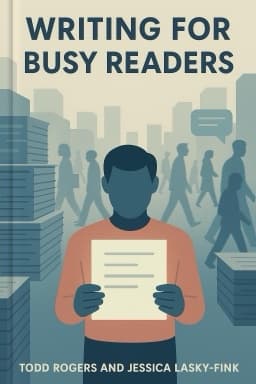
For more detailed strategies, Todd Rogers’ "Writing for Busy Readers" offers research-based principles that can revolutionize how you write emails and other business communications.
Sources: Todd Rogers, Writing for Busy Readers; Stanford Graduate School of Business; DM Group Research [[0]](#__0) [[1]](#__1) [[2]](#__2)
Want to explore more insights from this book?
Read the full book summary