
Why Your Busy Readers Are Ignoring You (And How to Fix It Now!)
Unlock the secrets to capturing and holding the attention of overwhelmed readers in today’s fast-paced world.

We live in an age where information overload is the norm. Every day, people receive hundreds of emails, texts, and notifications vying for their attention. In this crowded landscape, your writing risks being lost in the noise unless it is designed specifically for busy readers.
Understanding the Mind of a Busy Reader
Busy readers have limited attention and cognitive capacity. They cannot process all incoming information and rely on mental shortcuts to decide what to engage with. Selective attention filters out much of what they see, focusing only on what seems immediately relevant or urgent. Multitasking, often mistaken for efficiency, is actually rapid task-switching that reduces comprehension and increases errors. Furthermore, attention depletes quickly, making sustained focus on long messages difficult.
How Busy Readers Decide to Engage
Before reading, busy readers ask themselves: Is this message worth my time? They use heuristics such as sender recognition, subject line clarity, and message length to make quick judgments. Present bias leads them to prioritize easy or enjoyable tasks over challenging ones, often postponing complex messages. Skimming is the norm rather than the exception, with readers scanning headings and bullet points to grasp key points rapidly.
Six Principles to Write for Busy Readers
Drawing on Todd Rogers’ research, here are six essential principles:
- Brevity: Use fewer words and prioritize key ideas to respect readers’ limited time.
- Simplicity: Choose common words and short sentences to increase accessibility.
- Clarity of Purpose: Define your writing goals clearly to focus your message.
- Design for Navigation: Use headings, bullet points, and lead with important information for easy scanning.
- Formatting with Purpose: Employ bold and highlighting sparingly to guide attention without overwhelming.
- Empathy: Understand and respect your readers’ cognitive limits and time constraints.
Practical Tips to Get Started
Start every message by asking: What is the one thing I want my reader to know or do? Cut all extraneous information. Use simple language and short sentences. Format your text with clear headings and bullet points. Bold only the most critical words or phrases. And always proofread to eliminate errors that undermine credibility.
By embracing these strategies, you not only increase the chances your message will be read but also inspire action and build trust with your audience. Writing for busy readers is a skill that pays dividends across professional and personal communication.
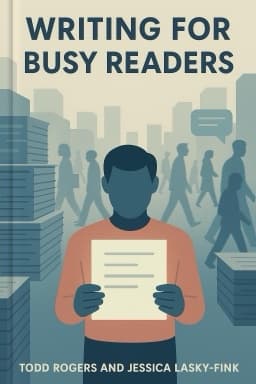
For a deeper dive into these principles and more, explore Todd Rogers’ book "Writing for Busy Readers," which combines rigorous research with practical advice to transform how you communicate in today’s fast-paced world.
Sources: Todd Rogers, Writing for Busy Readers; Stanford Graduate School of Business Insights; DM Group Research on Effective Writing [[0]](#__0) [[1]](#__1) [[2]](#__2)
Want to explore more insights from this book?
Read the full book summary