
Unlock Your Mind: How to Outsmart Your Brain’s Sneaky Biases and Think Smarter Today
Discover the hidden mental traps that cloud your judgment and learn science-backed ways to reclaim clarity and control.
Imagine your brain as a storyteller, constantly weaving a narrative that makes sense of the world around you. This story is not just entertainment; it shapes your identity, your memories, and your perceptions. But what if the storyteller is prone to errors, biases, and illusions? Welcome to the fascinating world of cognitive biases, where your mind plays tricks on you in subtle and surprising ways.
Narrative Bias: The Stories We Tell Ourselves
From the moment you wake up, your brain constructs a continuous story with you as the protagonist. This narrative helps you make sense of complex realities by simplifying them into cause and effect, heroes and villains. However, this storytelling comes with a cost. Memories are not perfect recordings but reconstructions, rewritten each time you recall them to fit your current beliefs and emotions. This means your past is fluid, shaped by your present self. For example, consider how three men each believed they were the same historical figure, defending their identity fiercely despite contradictory evidence. This illustrates how deeply entrenched personal narratives resist change and how your mind protects your sense of self by clinging to familiar stories.
The Illusion of Consensus: When Popular Beliefs Mislead
Just because many people believe something doesn’t make it true. This common belief fallacy explains why myths like 'fan death' persist despite scientific evidence. History also shows us the phlogiston theory, a long-held scientific misconception about combustion, which was only corrected after rigorous inquiry. Our need for social conformity and certainty makes us susceptible to accepting popular but false ideas. The scientific method, with its emphasis on disconfirmation and evidence, is our best tool to overcome these collective errors.
When Actions Shape Beliefs: The Benjamin Franklin Effect
Have you ever noticed that after doing a favor for someone you don’t particularly like, you start to feel more positively toward them? This counterintuitive phenomenon is explained by self-perception and cognitive dissonance theories. Your brain observes your actions and infers your attitudes from them, adjusting beliefs to reduce internal conflict. This explains why behavior can lead attitude, not just the other way around.
The Magic of Timing: Understanding the Post Hoc Fallacy
We are wired to seek cause and effect, but sometimes this leads us astray. The post hoc fallacy makes us believe that because one event follows another, the first caused the second. This fallacy fuels superstitions, like athletes’ lucky rituals or the pressing of placebo buttons that don’t actually work but give a sense of control. Even the placebo effect, where inert treatments cause real symptom relief, highlights the power of expectation and ritual.
The Halo Effect: When One Trait Colors All Others
We often let a single positive trait, like physical attractiveness or height, influence our overall impression of a person. This halo effect distorts our judgment, affecting hiring decisions, social interactions, and even legal outcomes. Taller people tend to earn more and be perceived as more capable, while attractive individuals are often assumed to be more intelligent and trustworthy, regardless of their actual qualities.
Willpower’s Hidden Cost: The Science of Ego Depletion
Self-control is like a muscle that gets tired with use. The more you resist temptation or exert discipline, the more your willpower drains, leading to lapses later. Social rejection also saps this mental energy, making it harder to regulate impulses. However, rest, glucose intake, and mindfulness can replenish willpower, helping you maintain better control over your actions.
Dressing the Mind: How Clothes and Symbols Shape Cognition
What you wear can change how you think and perform. This phenomenon, called enclothed cognition, shows that wearing symbolic attire like a lab coat or uniform can boost confidence, focus, and authority. Clothing acts as a psychological cue, influencing self-perception and behavior in subtle but powerful ways.
By uncovering these hidden mental influences, you gain the power to think more clearly, make better decisions, and treat yourself with compassion when your brain inevitably trips up. Your mind is a wondrous but imperfect storyteller—learning its language is the first step to mastering your own story.
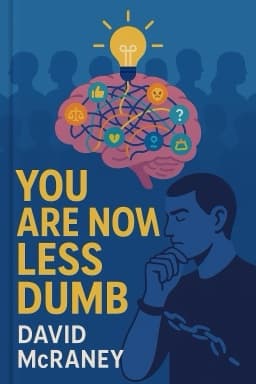
Sources include insights from the book You Are Now Less Dumb and related psychological research, blending humor, neuroscience, and real-world examples to illuminate the quirks of human cognition. 1 3 4
Want to explore more insights from this book?
Read the full book summary