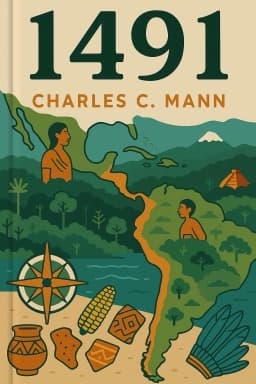
Charles C. Mann
A comprehensive reexamination of the Americas before Columbus, revealing populous, complex indigenous societies and their profound impact on the environment and history.
The Maya were the first to develop the concept of zero, independently of the Old World.
2 more facts available in the app
Section 1
9 Sections
Imagine soaring high above the vast plains of Bolivia’s Beni region, a landscape that might first appear as a natural expanse of grassland scattered with occasional patches of forest. But look closer, and you begin to notice something remarkable: thousands of nearly perfect circular forest islands, each rising like an emerald jewel from the golden sea of savanna. These islands are not random or natural oddities—they are the remnants of ancient human ingenuity.
The Beni’s human footprint is a masterpiece of ecological engineering. The forest islands provided refuge above seasonal floodwaters, allowing trees to thrive where they otherwise could not. The causeways, straight and unyielding, connected these islands, serving as roads and communication lines in a watery world. Fish weirs trapped abundant aquatic life, feeding entire communities. And for centuries, controlled fires maintained the grasslands, preventing encroachment by unwanted trees and fostering species adapted to fire. This was a landscape actively managed and sustained by human hands.
Such discoveries overturn the long-held myth of the Americas as an untouched wilderness before European arrival. Instead, the hemisphere was a dynamic, populous, and intricately managed environment. Indigenous societies were not passive occupants of the land; they were its architects and caretakers.
But the Beni is only one example among many. Across the Americas, from the mound-builders of the Mississippi Valley to the dense settlements along the Amazon River, ancient peoples created vibrant, complex worlds. As we journey deeper into this story, we will explore the populations that inhabited these lands, their origins, and the profound ways they influenced their environments. Let us now turn from the landscape itself to the remarkable peoples who shaped it.
What evidence suggests that the Beni region was heavily modified by ancient peoples?
17 more quizzes available in app
The Americas were not untouched wilderness but landscapes actively shaped by indigenous peoples.
8 more insights available in app
Unlock all 9 sections, 9 insights, full audio, and interactive mind map in the SnapBooks app.
Unveiling the vibrant and complex world of the Americas before European contact
Read articleThe devastating role of disease in reshaping the Americas after 1492
Read article