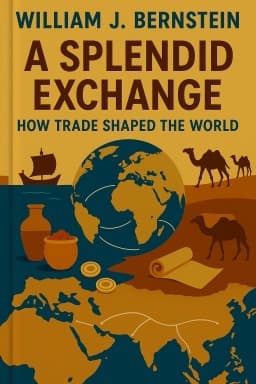
William J. Bernstein
A comprehensive history of global trade revealing its profound impact on human civilization from ancient times to the modern era.
The ancient Silk Road was not a single road but a network of trade routes spanning over 4,000 miles.
2 more facts available in the app
Section 1
9 Sections
Imagine a world tens of thousands of years ago, where early humans, equipped with sharp obsidian tools, began to venture beyond their immediate surroundings. These tools, prized for their razor-sharp cutting edges, were not locally available everywhere. Instead, obsidian had to be transported over vast distances, sometimes hundreds of miles, evidence that long before the rise of cities or empires, humans engaged in trade.
To facilitate such exchange, early humans innovated remarkable technologies. One such breakthrough was the sewn animal skin boat, a fragile yet effective vessel constructed by stretching animal hides over flexible frames. These boats predated the more commonly imagined dugout canoes and allowed hunters and traders to traverse rivers and coastal waters, vastly extending their reach.
As agriculture took root, settlements like Uruk in Mesopotamia emerged as centers of production and trade. These early cities became hubs where grain, textiles, and metals flowed along complex networks. The rise of writing, particularly cuneiform on clay tablets, was driven in part by the need to record transactions, debts, and contracts. Some tablets reveal loans extended by investors to traders, outlining profit-sharing agreements and risks.
This era saw the domestication of animals like donkeys and camels, which revolutionized land transport by carrying heavier loads over long distances. The interplay of these innovations—tools, transport, and record-keeping—set humanity on a path toward interconnected economies.
As we conclude this glimpse into our distant past, we recognize that the seeds of global trade were sown in these humble beginnings. The journey from obsidian flakes to bustling ancient markets is a testament to human ingenuity and the innate drive to connect and exchange.
Now, as we move forward, let us explore how the rise of Islam transformed trade across continents, uniting vast regions under a shared commercial and spiritual framework.
What was one of the earliest commodities traded by prehistoric humans?
17 more quizzes available in app
Trade began as a necessity for survival and evolved through innovation in tools and transport.
8 more insights available in app
Unlock all 9 sections, 9 insights, full audio, and interactive mind map in the SnapBooks app.
Discover how trade evolved from prehistoric barter to the digital age, shaping human civilization in ways you never imagined.
Read articleUncover how a 19th-century shipping innovation transformed global diets and economies forever.
Read article