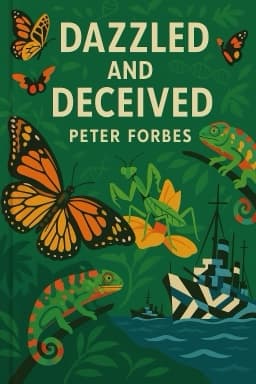
Peter Forbes
An interdisciplinary journey through the science, art, and history of mimicry and camouflage in nature and warfare.
The term 'camouflage' was coined by the French in 1917 during World War I.
2 more facts available in the app
Section 1
9 Sections
Imagine stepping into the dense, humid Amazon rainforest, where the air hums with life and the colors of butterflies flit like living jewels beneath the canopy. In this vibrant world, the story of mimicry begins—a tale of survival, deception, and the silent artistry of evolution.
In the mid-19th century, a young explorer ventured into these tropical realms, collecting butterflies and observing their peculiar patterns. He noticed that certain butterflies, although harmless and palatable, bore the exact wing patterns of other species that were toxic and avoided by predators. This was not mere coincidence but a brilliant evolutionary strategy: by copying the warning colors of their toxic neighbors, these mimics gained protection from predation. This phenomenon, now known as Batesian mimicry, revealed a new dimension of nature’s cunning.
But the story deepens. In Asia, another naturalist observed female swallowtail butterflies that did not conform to a single appearance. Instead, females from the same brood displayed several distinct forms, each mimicking a different toxic species. This polymorphism spread the risk of predation across multiple models, enhancing survival. It was a living puzzle of adaptation and complexity.
Further studies uncovered mimicry rings—groups of unpalatable species sharing the same warning coloration to reinforce predator avoidance. This mutualistic mimicry, called Müllerian mimicry, showed nature’s cooperative side, where species band together for collective defense.
These discoveries connected mimicry to the grand theory of evolution by natural selection.
As we journey forward, we will explore the genetic secrets behind these patterns, the artistic inspirations they provided, and their surprising applications in human history. But first, let us step deeper into the biological fabric that weaves these visual marvels.
Let us move now from the explorers’ tales to the very cells and genes that make mimicry possible.
What is Batesian mimicry?
15 more quizzes available in app
Mimicry evolved as a survival strategy where species copy others to avoid predation.
8 more insights available in app
Unlock all 9 sections, 9 insights, full audio, and interactive mind map in the SnapBooks app.
Discover how nature’s masterful deception shapes survival and evolution
Read articleTracing the journey of nature’s disguise from forests to frontlines
Read article
Frans de Waal

Stephanie Cacioppo

Rebecca K. Smith
Thor Hanson
