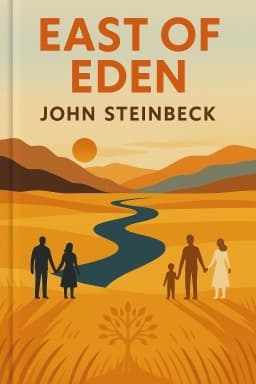
Let’s begin our journey in the heart of California, where the Salinas Valley unfolds like a living tapestry. Imagine the soft golden hills rolling under the early sun, the Gabilan Mountains to the east gleaming with the promise of hope, and the dark Santa Lucias to the west brooding with secrets and shadows. Here, the land is not just a backdrop, but a soul—its moods and rhythms shaping the destinies of everyone who treads its soil.
As the story opens, the valley breathes with memory. It remembers the first wildflowers of spring, the scent of maidenhair under mossy banks, the joy of children chasing toads at dawn. The soil is rich, but it is not always generous. Some years, rain falls in abundance and the fields burst into color—lupins edged in white, poppies glowing like liquid gold. Other years, drought cracks the earth, and the wind scrapes the land bare, leaving farmers to boast about surviving what little they have. The cycles of nature are as unpredictable as the cycles of fortune that shape the families who live here.
But the valley is more than a place of beauty and hardship. It is a crucible for moral choices. The mountains are not just boundaries—they are symbols. The Gabilans, bright and inviting, call to the spirit to rise, to aspire, to seek goodness. The Santa Lucias loom darkly, whispering of danger, loss, and the ever-present threat of falling into shadow. Every sunrise over the Gabilans is a promise; every nightfall from the Santa Lucias is a warning.
The river, too, is part of this living soul. Sometimes it rages, swallowing barns and livestock in a muddy torrent. In dry summers, it sinks beneath the sand, leaving only hidden pools where children search for tadpoles and dreams. The river teaches that life is both fleeting and eternal, that what is lost may return, and what is present may slip away.
As settlers arrive—Indians, Spaniards, Americans—they name the land for saints, for beauty, for hope, for the animals and flowers they find. Each name is a story, each story another layer in the valley’s deep memory. The land shapes its people as much as they shape it, and every generation must learn to listen to its lessons.
In this valley, hope and hardship, joy and sorrow, are as natural as the passing seasons. The land is both a blessing and a test, a place where every family must plant its roots and weather the storms. To understand the valley is to understand the heart of the story itself.
As we move forward, let us remember: the land sets the stage, but it is family that brings the drama. In the next section, we will meet the families whose destinies are woven into the very soil of the Salinas Valley.