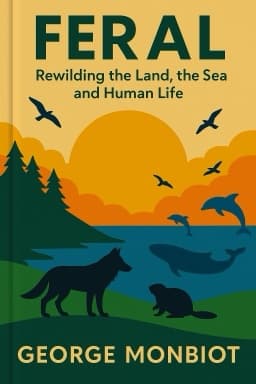
George Monbiot
A visionary manifesto on restoring natural ecosystems and reconnecting humans with the wild through rewilding.
Rewilding includes reintroducing missing species like wolves, beavers, and even potentially elephants in Europe.
Section 1
8 Sections
Imagine a world where the wild is not just a distant memory but a living, breathing reality around us. This world is not a fantasy but a possibility that calls to the deepest parts of our being. For centuries, we have been told stories that paint wolves as monsters, yet the truth is far less terrifying. In fact, in the entire 21st century, wolves in North America have been responsible for only one death.
But why do these fears persist? Perhaps because wolves embody traits that mirror our own social intelligence, their eyes seeming to read our minds, stirring a primal recognition. This uneasy familiarity may be why wolves have become symbols in folklore and film, sometimes transforming into humans and vice versa.
Yet, beyond fear, there is a yearning—a craving for a wilder, rawer life that many of us feel but cannot articulate. This feeling is what ecological boredom describes: a dullness born from living in sanitized, controlled environments where nature is reduced to tame parks and distant wildlife documentaries. The word that captures this longing is 'rewilding,' a relatively new term that has grown to encompass much more than its original meaning of releasing captive animals into the wild.
Today, rewilding is a call to restore the natural processes that have been suppressed. It is about letting ecosystems find their own way, free from human micromanagement. It involves reintroducing missing species, removing artificial barriers, and allowing landscapes and seascapes to heal and evolve. But crucially, it also invites us to rewild our own lives, to reconnect with the wildness within us without abandoning the benefits of civilization.
This dual aspect of rewilding—ecological and human—is what makes it so compelling. It offers hope and freedom, not constraint. It challenges us to break free from the monotony of modern life and rediscover the thrill and unpredictability that nature once provided.
As we embark on this journey, we begin to see that nature is not a static museum piece but a dynamic, self-willed entity. The ecosystems that emerge will not be identical to those of the past, but they will be vibrant and full of life, accessible to all who seek them. This vision is the foundation for the chapters that follow, where we explore the science, stories, and struggles of rewilding across land and sea.
Let us now move forward to understand the historical and ecological contexts that have shaped the landscapes we see today and why rewilding is both urgent and transformative.
Which of the following causes the most deaths annually in the US?
15 more quizzes available in app
Our fears of predators like wolves are often based on myths rather than facts.
8 more insights available in app
Unlock all 8 sections, 9 insights, full audio, and interactive mind map in the SnapBooks app.
Discover the transformative power of rewilding and why it’s the next big movement in saving our planet.
Read articleA deep dive into the fascinating science of how key species restore ecosystems and why their return is crucial.
Read article
Laurence C. Smith
Gaia Vince
Elizabeth Kolbert
David Attenborough
