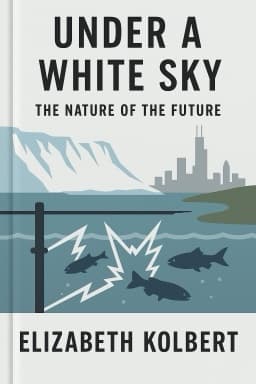
Elizabeth Kolbert
A compelling investigation into humanity’s escalating interventions in nature and the complex challenges of managing the Anthropocene.
The Chicago Sanitary and Ship Canal was one of the largest public works projects of its time, involving the removal of 43 million cubic yards of earth.
2 more facts available in the app
Section 1
10 Sections
Imagine standing on the banks of a river that once flowed naturally into a great lake, a source of fresh drinking water for millions. Now, picture that river reversed—its waters forced to flow backward by human hands. This is not a tale of fantasy but a reality forged at the dawn of the twentieth century when the city of Chicago undertook one of the most ambitious engineering feats of its time: reversing the flow of the Chicago River.
This reversal required removing an astonishing 43 million cubic yards of earth—enough to create an island a mile wide and 50 feet tall. It was a monumental human assertion of control over nature, a textbook example of the era’s confidence in engineering to solve environmental problems. Yet, as with many such interventions, it came with consequences that extended far beyond the city’s borders.
By connecting two previously separate drainage basins, the project inadvertently opened a corridor for aquatic species to cross boundaries that had stood for millennia. Invasive species, such as the aggressive Asian carp, found their way upstream and downstream, threatening native ecosystems and fisheries. The river became a highway for biological invaders, complicating efforts to preserve biodiversity.
Alongside the physical transformation, the canal waters turned murky and polluted, flecked with debris like candy wrappers and Styrofoam, a visible reminder of the ongoing human footprint. Electric fish barriers were later installed to try to block the carp’s advance, but these too were imperfect solutions to a problem born of human alteration.
Standing on the deck of a pleasure boat navigating these waters, one can see the layers of human history, engineering ambition, and ecological complexity intertwined. The river is no longer just a natural feature but a symbol of our ability—and sometimes hubris—to remake the world.
What was the primary purpose of reversing the Chicago River’s flow?
19 more quizzes available in app
Human infrastructure projects can fundamentally alter natural systems with long-lasting ecological consequences.
8 more insights available in app
Unlock all 10 sections, 9 insights, full audio, and interactive mind map in the SnapBooks app.
Unveiling the monumental engineering feat that reversed a river and reshaped ecosystems forever.
Read articleA deep dive into the rapid disappearance of Louisiana’s coast and innovative engineering solutions to save it.
Read article
Laurence C. Smith

Gaia Vince
David Attenborough
George Monbiot
