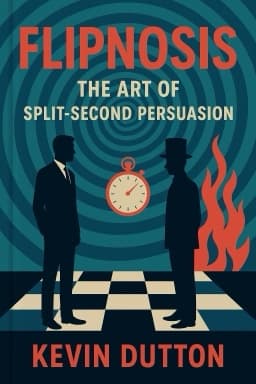
Kevin Dutton
A captivating exploration of the science behind split-second persuasion and how anyone can harness its power.
Kevin Dutton is a research psychologist who has worked with everyone from monks to special forces soldiers to understand persuasion.
Section 1
9 Sections
Let’s begin our journey into the art of split-second persuasion by traveling back—far, far back—into the ancient forests and swamps where life first learned to communicate. Here, persuasion is not a human invention, but a fundamental force of nature.
Imagine a frog, its throat pulsing with the resonant quonk-quonk of a mating call. This is not just noise; it is a key stimulus, a biological invitation that triggers a fixed action pattern in nearby females. The response is automatic, hardwired, and essential for the continuation of the species. This simplicity is the essence of persuasion in its purest form: direct, unambiguous, and effective.
But nature doesn’t stop at the obvious. Consider the cunning of plants and fungi. Some fungi infect blueberry leaves, coaxing them to emit scents and reflect ultraviolet light just like flowers. Bees, lured by these signals, become unwitting couriers, spreading the fungal spores as they would pollen.
Perhaps most fascinating is the phenomenon of supernormal stimuli. Researchers discovered that gull chicks, instinctively drawn to the red spot on their mother’s beak, would peck even more frantically at a stick painted with exaggerated red stripes. The lesson? Exaggeration can amplify persuasion—a principle echoed in the bold colors and shapes of modern advertising.
As we continue our story, let’s see how these primal forces manifest in the earliest moments of our own lives, shaping our every connection from the very beginning.
Which of these is an example of a key stimulus in animal persuasion?
17 more quizzes available in app
Simple cues in nature that trigger automatic responses.
7 more insights available in app
Unlock all 9 sections, 8 insights, full audio, and interactive mind map in the SnapBooks app.
Unlocking the Hidden Powers of Instant Influence — and How You Can Use Them Every Day
Read articleHow Persuasion Shapes Your Thoughts, Choices, and Even Your Identity—Without You Noticing
Read article