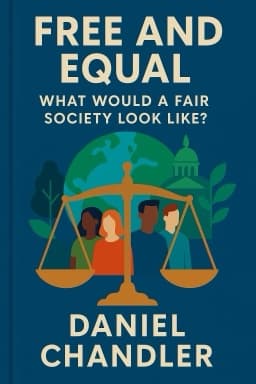
Daniel Chandler
A comprehensive exploration of John Rawls’s theory of justice applied to modern challenges, advocating for a fair, free, and sustainable society.
John Rawls’s 'A Theory of Justice' was published in 1971 and is considered one of the most important works in political philosophy of the 20th century.
1 more facts available in the app
Section 1
7 Sections
Imagine a world where the rules that govern us are chosen not by those with power or privilege, but by a group of individuals who know nothing about their own place in that world.
At the heart of this vision is the conviction that justice is the first virtue of social institutions. Just as truth guides our thinking, justice must guide our laws and social structures.
But fairness requires more than freedom; it demands equality of opportunity.
Yet, even with equal opportunity, inequalities will persist due to differences in talent and effort. Here, the difference principle offers a profound insight: inequalities are only justifiable if they benefit the least advantaged.
Consider a society where doctors earn more than hairdressers, not because they deserve more in a moral sense, but because higher pay incentivizes the demanding training and responsibilities of medicine.
Finally, justice extends beyond the present generation. The just savings principle reminds us that we have a duty to preserve the natural and social wealth of our society for those yet to come.
This foundation sets the stage for a society where freedom, equality, and sustainability are intertwined ideals, guiding us toward a fairer world. As we move forward, we will explore how these principles form the basis of a new social contract, one that can unite diverse citizens in shared purpose and respect.
What is the purpose of the 'veil of ignorance' in the original position?
13 more quizzes available in app
Justice should be based on principles everyone would agree to under fair conditions.
7 more insights available in app
Unlock all 7 sections, 8 insights, full audio, and interactive mind map in the SnapBooks app.
Discover the transformative power of Rawls’s theory and why it remains crucial in our divided world
Read articleWhy imagining ignorance might be the key to a fairer world
Read article
F. A. Hayek
Niccolò Machiavelli
Jonah Goldberg
Aristotle
