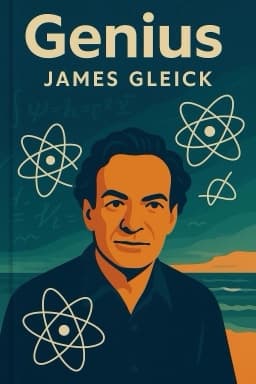
James Gleick
A detailed biography exploring the life, science, and legacy of physicist Richard Feynman.
Feynman was known for his playful personality, including his talent for playing the bongo drums.
Section 1
10 Sections
From the very beginning, the seeds of a great mind were planted not in grand lecture halls but in the humble confines of a childhood bedroom. Imagine a young boy, surrounded by bits and pieces of radios, wires, and glowing vacuum tubes, his fingers deftly manipulating switches and coils. This was not mere play; it was a dance with the invisible forces of nature.
Such early experiences were more than child’s play; they were the foundation stones of a scientific life. The boy’s relentless curiosity, nurtured by a family that saw value in his tinkering, allowed him to build not just circuits but a way of thinking.
His neighborhood, a blend of urban edges and open spaces, was a playground and a classroom. The freedom to explore, to roam fields and beaches, to observe the sky and the waves, provided a rich sensory tapestry.
In these formative years, the boy was not yet a physicist or a mathematician, but a natural scientist in the purest sense: an explorer of the unknown, guided by curiosity and a desire to understand. This period reminds us that genius often begins with simple questions asked with relentless passion.
As we move forward, we will see how this foundation of curiosity and hands-on learning shaped the man who would later revolutionize physics and change our understanding of the universe. Let us now journey into the halls of formal education, where raw talent meets the rigor of academia, and where our young explorer first tests the boundaries of his potential.
What early activity sparked Feynman's lifelong passion for science?
19 more quizzes available in app
Early curiosity and experimentation are critical to developing a scientific mindset.
8 more insights available in app
Unlock all 10 sections, 9 insights, full audio, and interactive mind map in the SnapBooks app.
Discover the extraordinary journey of a curious boy who became a revolutionary physicist and beloved educator.
Read articleExplore the philosophical insights and rebellious spirit that made Feynman a unique force in science.
Read article