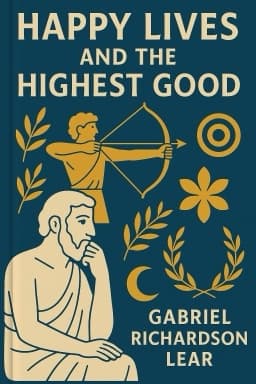
Gabriel Richardson Lear
A detailed philosophical analysis of Aristotle’s conception of happiness as the highest good, emphasizing contemplation as the ultimate end and integrating moral virtue as an essential approximation.
Gabriel Richardson Lear’s book is based on her PhD dissertation completed at Princeton University.
Section 1
7 Sections
Imagine the ancient world where philosophy was not just abstract thought but a guide to living well. At the heart of this inquiry lies a profound insight: every action, every choice, every craft we undertake aims at some good. This is not a casual observation but a foundational principle.
But what is this happiness? It is not a mere feeling of satisfaction or fleeting pleasure. Rather, it is the end for the sake of which we act; it is the reason behind our reasons. This conception of happiness as the ultimate end challenges us to think deeply about what makes life truly worthwhile. Is it wealth, honor, pleasure, or something else?
Aristotle’s text hints that happiness is a singular, unified good—a monistic end—rather than a collection of many disparate goods. This is crucial because if our lives are to be coherent and directed, they should aim at one ultimate goal, not a scattered set of aims. This insight sets the stage for exploring the nature of this highest good and how it governs the hierarchy of all other goods.
As we begin this journey together, keep in mind this image of directedness and finality. Our next step will be to explore what it means for an end to be truly final and how this finality shapes the pursuit of happiness.
According to Aristotle, what does every action and choice aim at?
13 more quizzes available in app
Understanding happiness as the final goal of all human activity.
7 more insights available in app
Unlock all 7 sections, 8 insights, full audio, and interactive mind map in the SnapBooks app.
Discover Aristotle’s timeless blueprint for a flourishing life and why understanding the 'highest good' can transform your worldview.
Read articleHow embracing Aristotle’s highest good can revolutionize your approach to happiness and success.
Read article