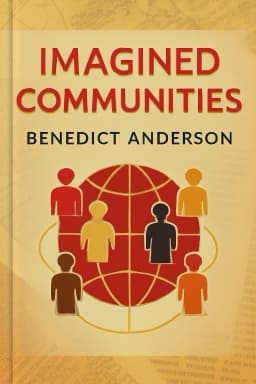
Benedict Anderson
A seminal study revealing nations as socially constructed 'imagined communities' shaped by print capitalism, culture, and political power.
Benedict Anderson originally wrote Imagined Communities in response to the nationalist conflicts in Southeast Asia during the late 1970s.
Section 1
9 Sections
Imagine a vast community where you never meet most of your fellow members, yet you feel a profound connection to them. This is the essence of a nation—an imagined political community.
Consider the example of the Tomb of the Unknown Soldier, a monument honoring unidentified fallen soldiers.
What defines this imagined community? First, it is limited.
Second, nations are sovereign. Emerging in an era when divine right monarchies lost legitimacy, nations claim direct authority over their territory and people.
Finally, nations are imagined as communities of comradeship, a horizontal fraternity among equals.
Understanding nations as imagined communities offers a fresh perspective on political identity. It reveals that nations are not eternal or natural but cultural artefacts shaped by history and imagination. This insight opens the door to exploring how these imaginations are formed and sustained.
Let us now journey deeper into the cultural roots that made such imaginations possible, tracing the decline of older forms of community and the rise of new temporal and spatial understandings that gave birth to nationalism.
Why are nations described as 'imagined communities'?
17 more quizzes available in app
The nation exists primarily in the shared imagination of its members rather than direct social ties.
8 more insights available in app
Unlock all 9 sections, 9 insights, full audio, and interactive mind map in the SnapBooks app.
Unveiling the Invisible Threads That Bind Millions into Nations
Read articleDebunking Myths and Revealing the Cultural Construction of Nations
Read article
Daron Acemoglu and James A. Robinson

David Cole

Victor Davis Hanson
Josh Rogin
