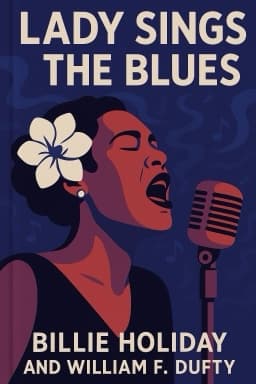
Billie Holiday and William F. Dufty
The raw and poignant autobiography of jazz icon Billie Holiday, revealing her life’s struggles, music, and legacy.
Billie Holiday’s autobiography was originally published in 1956 and has been a touchstone for jazz fans ever since.
2 more facts available in the app
Section 1
7 Sections
In the tender years of her childhood, the young girl who would become a jazz icon was already dancing with adversity. Born into hardship in Baltimore, she was surrounded by poverty and familial instability. Her mother, barely a teenager herself, worked tirelessly as a maid to keep them afloat, while her father’s dreams of music were cut short by the ravages of war. The neighborhood was tough, filled with the harsh realities of segregation and economic struggle, yet it was alive with the rhythms of emerging jazz culture.
This young girl’s earliest memories were not of lullabies but of scrubbing steps in front of white houses, fighting off the discomfort of a crowded household, and enduring the harsh discipline of relatives who misunderstood her spirited nature.
Her refuge came in the most unlikely of places: a local whorehouse parlor where a victrola spun records of Louis Armstrong and Bessie Smith. Here, amidst the smoke and whispered conversations, she first heard the soulful strains of jazz. The music was unlike anything she had known—wordless yet profoundly expressive, capable of conveying joy, sorrow, and every shade between. It stirred something deep within her, planting the seeds for a lifelong love affair with song.
Yet life’s cruelty was never far. At just ten years old, after a traumatic incident that no child should endure, she was placed in a Catholic institution. There, clothed in a blue and white uniform and given a saint’s name, she faced isolation and punishment. The institution was a world away from the vibrant streets of Baltimore, filled instead with cold walls and the silence of lost childhoods. She wore a raggedy red dress as punishment, a symbol of loneliness and exclusion. Yet even here, her spirit endured, pounding on the doors of despair with the same intensity that would later echo in her music.
Through these early trials, the young girl learned resilience. She found strength in the music she loved and in the stories passed down from her great-grandmother, a former slave who carried the weight of history in her heart. These stories lent a voice to the voiceless, a rhythm to the silenced.
This section of her story is a testament to how childhood hardship can forge an artist’s voice, imbuing it with authenticity and emotional power. It reminds us that beauty and pain often walk hand in hand, crafting the soul’s deepest expressions.
As we move forward, we will see how this foundation of struggle and music blossomed into a remarkable career, marked by passion, innovation, and the relentless pursuit of artistic truth.
Where did Billie Holiday first experience jazz music?
13 more quizzes available in app
Billie’s early life adversity laid the foundation for her emotionally rich and authentic music.
8 more insights available in app
Unlock all 7 sections, 9 insights, full audio, and interactive mind map in the SnapBooks app.
Discover the raw, emotional journey of Billie Holiday—from hardship to stardom, and the shadows she battled along the way.
Read articleUnpacking the unique musical style and collaborations that made Billie Holiday a revolutionary jazz singer.
Read article