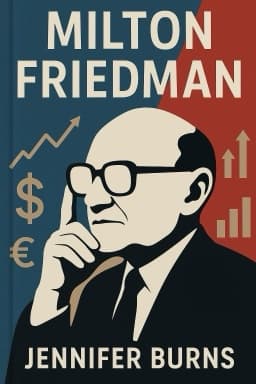
Jennifer Burns
A comprehensive biography exploring Milton Friedman's life, economic theories, political influence, and enduring legacy as a pivotal figure in twentieth-century economics and conservatism.
Milton Friedman was one of the few economists to predict stagflation in the 1970s.
2 more facts available in the app
Section 1
8 Sections
Every great journey begins with humble steps, and the story of this towering economic mind is no exception. Born into a Jewish immigrant family in a small New Jersey town, his early years were marked by the warmth of close-knit community life and the shadows of social prejudice. The family ran a modest dry goods store, a hub of local commerce and social interaction, where the rhythms of daily life unfolded against the backdrop of an America grappling with rapid change.
His academic talents shone brightly, yet life was not without its trials. The sudden loss of his father during his senior year thrust upon him new responsibilities and a sobering awareness of life's fragility. Yet, rather than dim his resolve, these events seemed to kindle a deeper determination. He embraced education as a beacon of opportunity, a belief captured in his own words about the land of opportunity where anything was possible. This optimism was not naïve but forged in the crucible of experience and reflection.
In the halls of Rutgers University, his journey continued. Initially drawn to mathematics with dreams of becoming an actuary, he encountered economics almost by chance. The field, though in a period of quiet, soon revealed itself as a gateway to understanding the pressing questions of his time — questions about prosperity, unemployment, and the very fabric of society. Under the mentorship of a young professor who would become a lifelong guide, he absorbed lessons on business cycles and institutional economics, blending empirical rigor with a restless search for deeper truths.
These formative years were not just about learning theories but about shaping a worldview — one that valued individual freedom, skepticism of unfettered government control, and a belief in the power of markets to coordinate human activity. Yet, he was also keenly aware of the imperfections and crises that challenged these ideals.
As this chapter closes, we see the emergence of a thinker poised at the intersection of tradition and innovation, ready to embark on a path that would transform economics and politics. The next section will delve into the rigorous academic crucible of Chicago and Columbia, where his ideas began to crystallize and his lifelong partnerships took shape.
What early experience foreshadowed his future as a communicator and thinker?
15 more quizzes available in app
His immigrant family and small-town Jewish community created both a protective environment and challenges that shaped his early worldview.
8 more insights available in app
Unlock all 8 sections, 9 insights, full audio, and interactive mind map in the SnapBooks app.
Discover the fascinating journey of the economist who reshaped modern economics and politics with ideas that still echo today.
Read articleUnpacking the monetarist theory that challenged Keynesian dominance and reshaped central banking worldwide.
Read article