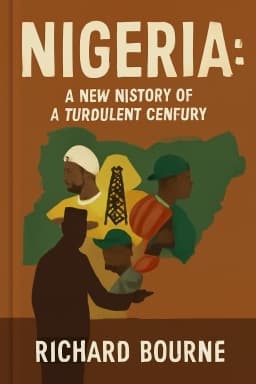
Richard Bourne
A detailed historical account of Nigeria’s century-long journey through colonialism, independence, conflict, and the quest for unity.
Nigeria is Africa’s most populous country, with over 200 million people.
1 more facts available in the app
Section 1
7 Sections
As we begin our journey through the turbulent century of Nigeria’s history, we find ourselves at the dawn of a new nation forged not by the will of its peoples but by the designs of empire.
The name Nigeria itself was not born from within but was the invention of a British journalist, a woman whose vision of the Niger River basin became the label for this vast and diverse land. The economic rationale behind the amalgamation was stark: the richer south, with its palm oil and cocoa exports, ran a surplus, while the vast north was a financial drain on the colonial treasury.
Yet, beneath the surface of railways and treaties, there were profound cultural and political consequences. The indirect rule system preserved the power of emirs in the north but imposed artificial chiefs in the south, disrupting indigenous governance and alienating the emerging educated elite.
Despite the heavy hand of empire, the peoples of Nigeria maintained their rich traditions and complex identities. The British conquest did not erase centuries of history but layered new challenges on an already intricate social fabric. As the first section of our exploration closes, we see a nation born in contradiction—united by colonial fiat but divided by culture, economy, and governance.
Let us now move forward to the next chapter—the impact of global conflict on this young nation and the awakening of a collective consciousness that would fuel the fires of nationalism.
What was the primary reason for the amalgamation of Northern and Southern Nigeria in 1914?
13 more quizzes available in app
The creation of Nigeria as a single colony was an administrative and economic decision with lasting implications.
8 more insights available in app
Unlock all 7 sections, 9 insights, full audio, and interactive mind map in the SnapBooks app.
Unveiling the origins of Nigeria’s complex identity and the colonial decisions that still echo today
Read articleTracing the impact of global wars and local uprisings on Nigeria’s path to independence
Read article