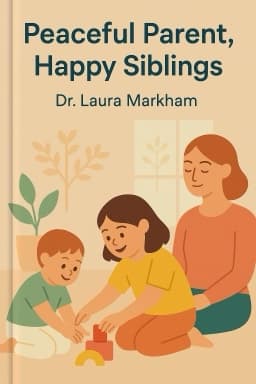
Dr. Laura Markham
A practical guide for parents to foster loving, cooperative sibling relationships through peaceful parenting and emotional coaching.
Research shows that children of parents who regulate their emotions have better sibling relationships.
Section 1
7 Sections
Imagine a home where the echoes of shouting are replaced by soft voices and laughter. This transformation begins not with the children, but with the parent.
Consider the story of two households: In one, parents frequently yell and punish, leading to siblings who fight often and use threats or force to get their way. In the other, parents consciously practice calmness and empathy, coaching their children to express feelings and solve problems. Over time, the children in the second household fight less and show more kindness.
Why does punishment backfire? Because it teaches children that controlling others through fear is acceptable. When a child is punished for hitting a sibling, they may stop hitting to avoid punishment but do not necessarily feel empathy for their sibling. Worse, they might use threats or tattling as tools to gain advantage, increasing rivalry.
But how do parents begin this journey? It starts with self-awareness: noticing when their own emotions rise and using simple techniques like deep breathing to recenter. One parent shared that just counting five deep breaths before intervening in a sibling fight transformed the household atmosphere. The children mirrored that calm and began resolving conflicts more peacefully.
Connection is the next vital ingredient. Children need to feel heard, understood, and valued. When they do, they want to cooperate because they don’t want to jeopardize that relationship. This connection motivates children far more effectively than any punishment or reward.
Finally, coaching replaces controlling. Instead of demanding compliance, parents guide children to express their feelings, understand others, and find solutions. This builds intrinsic motivation and lifelong social skills. Imagine a child saying, “I’m still playing with that, Jonah. Can I have it back, please?” instead of hitting or yelling. That is the fruit of coaching.
These three pillars—self-regulation, connection, and coaching—are the foundation for peaceful parenting and happier siblings. They require commitment and practice but offer profound rewards. As you internalize these ideas, you prepare to explore how to teach your children the emotional intelligence skills they need to thrive together.
What is the key factor in improving sibling relationships?
13 more quizzes available in app
Parents who regulate their emotions model calmness, which children emulate, reducing sibling fights.
8 more insights available in app
Unlock all 7 sections, 9 insights, full audio, and interactive mind map in the SnapBooks app.
Discover proven strategies to transform sibling rivalry into lifelong friendship through empathy, emotional coaching, and connection.
Read articleUncover the hidden reasons behind sibling fights and learn how to turn rivalry into relationship building.
Read article
Gordon Neufeld, Ph.D. and Gabor Maté, M.D.

Shefali Tsabary, PhD
Lauren Smith Brody

Daniel J. Siegel, M.D. and Tina Payne Bryson, Ph.D.
