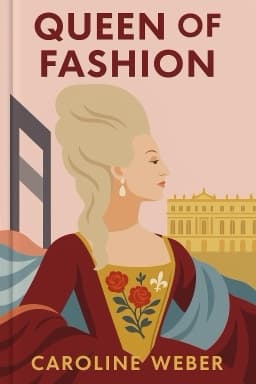
Caroline Weber
An insightful biography exploring how Marie Antoinette's fashion choices shaped her political fate and legacy during the French Revolution.
Marie Antoinette popularized the towering pouf hairstyle, which could reach heights of over two feet and incorporate symbolic decorations.
2 more facts available in the app
Section 1
9 Sections
As we embark on this journey through the life of one of history’s most fascinating figures, we begin with a story of transformation — a passage marked not only by geography but by identity. Imagine a young Austrian archduchess, tender in age and upbringing, preparing to cross foreign lands to become the Dauphine of France. This journey was more than a mere relocation; it was a metamorphosis, orchestrated with painstaking care and immense political weight.
From the earliest days, Marie Antoinette was immersed in the language of fashion as power. Before setting foot in France, she was introduced to the world of Parisian couture through the medium of exquisitely crafted miniature mannequins known as 'Pandoras.' These dolls, dressed in the latest styles, were her first glimpse into the sartorial codes she would soon embody. They served as both guides and symbols — a tangible link between her Austrian origins and the French court she was destined to join.
The investment in her wardrobe was staggering. Her mother, the Empress, spared no expense, spending four hundred thousand livres — a fortune by any measure — to ensure that her daughter’s trousseau was not only sumptuous but wholly French-made. This was a deliberate declaration: the young bride would not merely arrive in France; she would arrive as a vision of Franco-Austrian alliance, wrapped in the finest silks, brocades, and jewels that the French ateliers could produce.
But this transformation extended beyond fabrics and jewels. It was a process of physical alteration designed to meet the exacting standards of Versailles. Crooked teeth were straightened through painful dental work, and unruly locks were tamed into the powdered pompadour coiffure, aligning her appearance with the expectations of a French princess. Portraits were commissioned to capture this new image, ensuring that even those who could not see her in person would recognize the perfect embodiment of royal grace.
As she prepared to leave the familiar halls of the Hofburg, the young archduchess was enveloped in layers of symbolism and expectation. Her carriage, a jewel box on wheels, glittered with gold and glass, a moving palace that bore her away from home and toward her destiny. Yet beneath the finery and ceremony lay the poignant reality of separation and the daunting unknown.
This transformation was not without its emotional toll. The girl who had once played with dolls now became herself a living doll — a figure to be admired, scrutinized, and judged by a court whose rules were as rigid as the stays that would soon shape her waist. Every stitch, every bow, every powdered curl was a thread in the tapestry of her new life.
As we close this chapter of beginnings, we see how Marie Antoinette’s arrival in France was not simply the crossing of a border, but an immersion into a world where fashion was a currency of power, and where the body itself became a stage for political drama. The next section will unveil the ceremony that marked her official transformation, a ritual that stripped away her past and clothed her anew in the mantle of French royalty.
What was the primary purpose of the 'Pandoras' fashion dolls?
17 more quizzes available in app
Marie Antoinette’s physical and cultural makeover was a carefully orchestrated process symbolizing her transition from Austrian princess to French Dauphine.
7 more insights available in app
Unlock all 9 sections, 8 insights, full audio, and interactive mind map in the SnapBooks app.
Discover how Marie Antoinette’s wardrobe was more than just clothing—it was a language of power, politics, and identity that shaped history.
Read articleUnpacking the bold style choices that redefined royal fashion and sparked cultural shifts still felt today.
Read article
Jack Fairweather
Philip Freeman

Benjamín Labatut
Greg King and Penny Wilson
