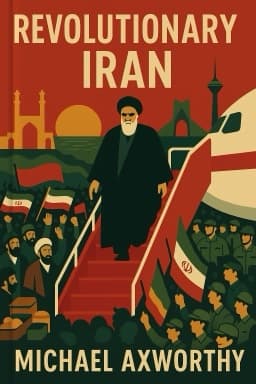
Michael Axworthy
A detailed history of Iran's Islamic Republic, exploring its revolutionary origins, war, political evolution, and ongoing challenges.
The Iranian Revolution of 1979 was the first modern revolution to establish an Islamic state.
2 more facts available in the app
Section 1
9 Sections
Imagine a land where faith and identity intertwine so deeply that religion becomes the very soul of a nation. This is Iran, a country where Shi‘a Islam is not merely a faith but the foundation of political authority and social cohesion. The story begins centuries ago, when the Safavid dynasty, in 1501, declared Shi‘ism the state religion, transforming the religious landscape of Iran and forging a unique identity that persists to this day.
The Shi‘a clergy developed a structured hierarchy, with ranks such as mojtahed, who are authorized to interpret religious law, and marja-e taqlid, the supreme sources of emulation. This hierarchy, akin to a religious judiciary, gave the clergy the power to arbitrate disputes, enforce morality, and even challenge secular rulers.
Beyond the halls of power, popular religious practices like the Ashura procession echo through the streets of Iran every year. These processions commemorate the martyrdom of Emam Hosein at Karbala, a defining moment of Shi‘a history symbolizing the triumph of righteousness over tyranny. Participants beat their chests, carry symbolic banners, and reenact scenes of sacrifice, creating a shared sense of identity and collective memory.
Such traditions are not mere pageantry; they form a political language accessible to all Iranians, from the bazaari merchants to the rural villagers. The close relationship between the clergy and the bazaars has historically been a backbone of Iranian society, intertwining economic and religious life. This alliance proved crucial during political upheavals, as these groups could mobilize masses in defense of their shared values.
Understanding Iran’s modern political landscape requires appreciating this deep-rooted religious identity. The Islamic Republic, established decades later, draws heavily on this legacy, blending religious authority with governance. The tension between divine authority and popular will has shaped Iran’s history from the Safavids to the present.
As we move forward, we will see how this religious and cultural foundation influenced Iran’s first major modern political upheaval — the Constitutional Revolution — and how the struggle for democracy intertwined with the power of the clergy. Let us now journey into the early 20th century, where the seeds of modern Iranian nationalism and constitutionalism were sown amidst foreign pressures and internal tensions.
What distinguishes Shi‘a Islam’s religious leadership from Sunni Islam?
17 more quizzes available in app
Shi‘ism’s religious structure provided a framework for political authority and social organization unique to Iran.
8 more insights available in app
Unlock all 9 sections, 9 insights, full audio, and interactive mind map in the SnapBooks app.
A Deep Dive into Iran’s Complex Journey Through Religion, Revolution, and Resilience
Read articleThe Untold Story of the CIA and British Role in Toppling Iran’s Democratically Elected Leader
Read article