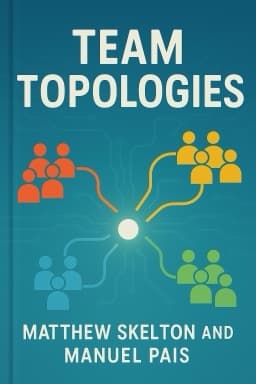
Matthew Skelton and Manuel Pais
A practical framework for designing and evolving software teams and interactions to enable fast, adaptive software delivery.
The concept of Team Topologies builds heavily on Conway’s Law, a principle first stated in 1968.
Section 1
10 Sections
Imagine an orchestra tuning before a concert. Each musician is preparing individually, yet the harmony they create depends deeply on how they listen and respond to each other. In the world of software development, the teams building systems resemble this orchestra. The invisible threads weaving their communication patterns ultimately shape the music — or in this case, the software architecture.
Consider a company where development teams are divided strictly by function — front-end, back-end, and database specialists each in their own silo. The communication bottlenecks between these groups often lead to a software architecture that is similarly segmented, with tightly coupled components and shared databases that slow down delivery and increase risk. In contrast, when teams are organized around product features or customer journeys, communication flows more naturally within the team, enabling modular, loosely coupled architectures that accelerate change.
But this is easier said than done. Communication is organic and dynamic, influenced by culture, tools, and physical spaces. An organization must cultivate an environment where teams can communicate effectively without overwhelming each other, balancing collaboration and autonomy.
As we embark on this journey through the principles of Team Topologies, keep in mind that understanding these invisible threads is the key to unlocking faster, safer, and more adaptive software delivery. In the next section, we will explore how the mental bandwidth of teams — their cognitive load — shapes their ability to deliver and innovate, and how respecting these limits is crucial for sustainable success.
What does Conway’s Law primarily suggest?
19 more quizzes available in app
Software architectures mirror team communication structures.
8 more insights available in app
Unlock all 10 sections, 9 insights, full audio, and interactive mind map in the SnapBooks app.
Discover the revolutionary framework that’s transforming how tech teams deliver software faster and smarter.
Read articleThe hidden team dynamics that sabotage your projects — and the proven framework to turn things around.
Read article
Marty Cagan

Tim Higgins
Malcolm Frank, Paul Roehrig, and Ben Pring
Chris Anderson
