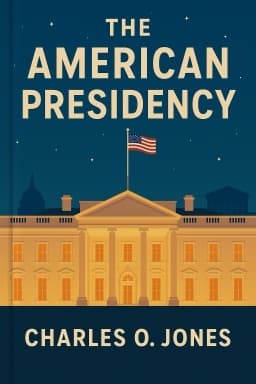
Charles O. Jones
A concise exploration of the American presidency's constitutional origins, evolution, powers, challenges, and reforms within the U.S. government.
The title 'president' was chosen because it was seen as less threatening than 'governor' or 'king,' reflecting the Founders' wariness of executive power.
2 more facts available in the app
Section 1
6 Sections
Imagine the summer of 1787 in Philadelphia, a room filled with some of the most brilliant minds of the era, wrestling with a daunting question: How to create an executive leader for a new nation without repeating the mistakes of monarchy or tyranny? The answer was not simple.
At the heart of this design was the principle of separation of powers, a system where the executive, legislative, and judicial branches would check and balance each other. The presidency was not to be a solitary ruler but part of a government of 'separated institutions sharing powers.' The debates were fierce: Should the executive be a single person or a committee? How should the president be chosen? What powers should be granted? How long should the term be?
One of the most significant influences was the presence of George Washington, whose reputation as a reluctant leader and victorious general lent credibility to the new office. His personal humility and preference for retirement reassured skeptics that the presidency would not become a lifetime monarchy.
The Framers established the Electoral College as a compromise between direct popular election and congressional selection, ensuring a balance of state and federal interests. The impeachment process was crafted carefully to hold the president accountable without destabilizing the government.
Thus, the presidency was born not as a dominant ruler but as a leader entwined in a complex system of shared powers, requiring negotiation, persuasion, and cooperation. This delicate balance remains the essence of the American executive. As we move forward, we will explore how this unique electoral system evolved and how political parties shaped the presidency's role in practice.
Why was the title 'president' chosen over 'governor'?
11 more quizzes available in app
The presidency was created within a system designed to divide power among branches to prevent tyranny.
6 more insights available in app
Unlock all 6 sections, 7 insights, full audio, and interactive mind map in the SnapBooks app.
Discover how the American presidency evolved from a cautious experiment to a powerhouse of modern governance.
Read articleUnpacking the surprising strengths and constraints of the U.S. presidency in today’s political system.
Read article
Daron Acemoglu and James A. Robinson
David Cole

Victor Davis Hanson
Josh Rogin
