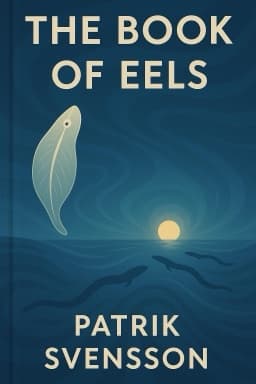
Patrik Svensson
An evocative journey into the life, mystery, and conservation of the European eel, blending science, culture, and personal narrative.
Eels can live for over 80 years, with some captive eels reportedly reaching 150 years.
2 more facts available in the app
Section 1
9 Sections
Imagine the vastness of the Atlantic Ocean, where a hidden cradle of life exists not bordered by land but by powerful ocean currents. This is the Sargasso Sea, a place of drifting brown algae fields and deep blue waters, where the European eel begins its extraordinary journey.
Upon arrival, these larvae metamorphose into glass eels, fragile and translucent, beginning their migration into freshwater streams and rivers. There, they grow into yellow eels, strong and muscular, living solitary lives for decades, adapting to their environment with a patience that seems to defy time itself.
Then, after many years, something awakens within the yellow eel. It transforms again into the silver eel, its body changing color and its organs preparing for the final, epic journey back to the Sargasso Sea to spawn and die.
What makes this life cycle so fascinating is not just the transformations themselves, but the mystery surrounding them. The Sargasso Sea is a realm of uncertainty, where life begins and ends for the eel, yet no human has ever witnessed its breeding.
As we begin to understand the eel’s journey, we see it as a metaphor for life's mysteries—patience, transformation, and the unknown. This sets the stage for exploring centuries of human fascination and the scientific quests to uncover the secrets of the eel, which we will explore next.
Where is the European eel born?
17 more quizzes available in app
The eel's life cycle is a complex journey involving multiple metamorphoses and migrations.
7 more insights available in app
Unlock all 9 sections, 8 insights, full audio, and interactive mind map in the SnapBooks app.
Dive deep into the mysterious life of the European eel and discover how centuries of human curiosity and modern science unveiled its secrets.
Read articleUnravel the centuries-old mystery of the European eel’s life cycle and the groundbreaking discoveries that changed marine science forever.
Read article