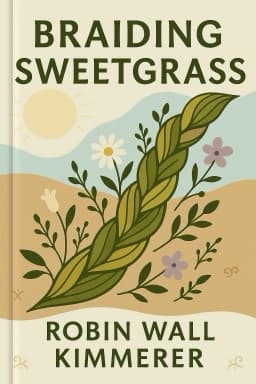
Robin Wall Kimmerer
A poetic blend of indigenous wisdom and scientific knowledge that teaches reciprocity and healing in our relationship with the natural world.
Robin Wall Kimmerer is a trained botanist and a member of the Citizen Potawatomi Nation.
Section 1
8 Sections
Imagine a time before time, when the world was nothing but sky and water. From this vast emptiness, a woman falls—Skywoman—carrying in her hand a small bundle of seeds. Her fall is gentle, cradled by the wings of geese and the back of a great turtle. Together, the animals create a new land on the turtle’s shell, a place where life can grow.
This ancient tale reminds us that the earth did not come into being by accident or by the will of one being alone. Instead, it was a collective act, a gift born of cooperation and gratitude. The seeds Skywoman carries are the first plants, the gifts that will sustain all life to come. Among these gifts is sweetgrass, known as wiingaashk, the hair of Mother Earth. Its fragrance is a reminder of the sacred bond between humans and the natural world.
Sweetgrass is not just a plant; it is a teacher. When braided, it symbolizes the weaving together of stories, knowledge, and life itself. The act of braiding requires tension and cooperation—one person holds steady while another weaves the strands together. This simple act embodies the principle of reciprocity, the understanding that we are linked with the earth and each other in a delicate balance of giving and receiving.
But what does it mean to live in reciprocity with the earth? It means recognizing that the gifts we receive are not ours to own outright but to steward with care.
In this story, the earth is not a commodity but a living web of relationships. The animals, plants, and humans are all kin, bound by mutual respect and responsibility. This perspective is more than myth; it is a guide for living sustainably and healing the rift between people and the land.
As we reflect on Skywoman’s fall and the birth of Turtle Island, we are called to remember the gifts we have forgotten. We are invited to hold the sweetgrass braid gently, to listen to the stories it weaves, and to learn the language of reciprocity.
With this foundation laid, we turn now to the language that shapes how we see the world—the grammar of animacy—and how learning to speak it can transform our connection to all living things.
What does the Skywoman story primarily teach us about our relationship with the earth?
15 more quizzes available in app
The story teaches that relationships with the earth are based on give and take, mutual care, and gratitude.
8 more insights available in app
Unlock all 8 sections, 9 insights, full audio, and interactive mind map in the SnapBooks app.
Discover the transformative power of indigenous knowledge and science intertwined in Robin Wall Kimmerer's masterpiece.
Read articleHow understanding the language of animacy can deepen our connection with the living world.
Read article