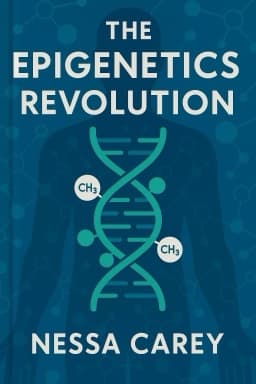
Nessa Carey
A detailed exploration of how epigenetic mechanisms regulate gene expression, influence development and disease, and challenge traditional genetics.
Epigenetic modifications can be influenced by diet, stress, and environmental toxins.
2 more facts available in the app
Section 1
9 Sections
Imagine a world where every cell in your body was thought to be locked in its fate, unable to return to a previous state or change into a different type. For decades, this was the prevailing belief in biology: as cells specialize, they irreversibly lose parts of their genetic blueprint. But then came a series of elegant experiments with humble toads that would change everything. By taking the nucleus from an adult toad cell and placing it into an enucleated egg, scientists witnessed something extraordinary — the egg developed into a fully formed tadpole. This meant that the adult cell had retained the entire genetic code necessary for life, even after years of specialization.
To visualize this, think of Waddington’s epigenetic landscape: a ball perched atop a hill, rolling down into one of many valleys, each representing a stable cell fate. Once the ball settles in a valley, it’s hard to push it back uphill or into another valley. Differentiated cells, like skin or nerve cells, are those balls nestled deep in their valleys. But the nuclear transfer experiments revealed that, under the right conditions, the ball could be nudged back to the top and redirected.
These insights laid the foundation for understanding epigenetics — the study of how gene expression is regulated without changing the underlying DNA sequence. It’s like having a script that can be interpreted in different ways, producing distinct performances from the same text. This revelation opened doors to cloning, regenerative medicine, and a new appreciation for how environment and history shape biology.
As we move forward, we will explore how scientists harnessed this knowledge to reprogram cells more efficiently and how these mechanisms operate at the molecular level to control gene activity. The journey from toad eggs to stem cells is a tale of scientific curiosity, persistence, and the beauty of nature’s complexity. Let’s continue to unravel this fascinating story.
What key discovery did the nuclear transfer experiments with toad eggs reveal?
17 more quizzes available in app
The process of transferring a nucleus from a differentiated cell into an enucleated egg to test genetic completeness.
8 more insights available in app
Unlock all 9 sections, 9 insights, full audio, and interactive mind map in the SnapBooks app.
Discover the revolutionary science that shows your DNA isn’t your destiny — and how your lifestyle and environment can rewrite your genetic story.
Read articleCould your diet, stress, or environment affect not just you but your children and grandchildren? Dive into the fascinating world of epigenetic inheritance.
Herman Pontzer, PhD
Lisa Randall

John Hands
Carlo Rovelli
