Imagine a world where the hum of machines was a new sound, a promise of progress and a whisper of fear. It was the dawn of automation, a time when factories transformed from bustling hives of human labor to orchestrated symphonies of gears, belts, and levers. The air was thick with the scent of oil and ambition. In these early days, automation was not just a technical term—it was a vision of a future where work would be easier, faster, and perhaps even more meaningful.
But as with every new chapter in human history, this vision was double-edged. The same machines that inspired awe for their precision and power also cast long shadows of uncertainty. Workers marveled at the beauty of intricate mechanisms, yet some feared the loss of their crafts, their livelihoods, and even their identities. The historian George Dyson captured this duality by calling us 'brothers and sisters of our machines,' suggesting that our inventions are as much a reflection of ourselves as they are tools for our use.
The word 'automation' itself was born not in a laboratory, but in a boardroom at Ford Motor Company in 1946. As engineers sought to describe the new push-button assembly lines that replaced human hands with mechanical arms, a vice president stumbled upon a term that would soon define an entire era. This new breed of machines was not content to simply aid; they could now operate autonomously, shifting the balance of power in factories and, eventually, in society.
Early automation was a marvel, but it was also a source of anxiety. For every manager who saw rising profits and efficiency, there was a worker who saw his role diminished or erased. The machines were beautiful and powerful, but they were also cold and indifferent. They could be liberators, freeing people from drudgery, or enslavers, reducing human beings to mere appendages of metal and code.
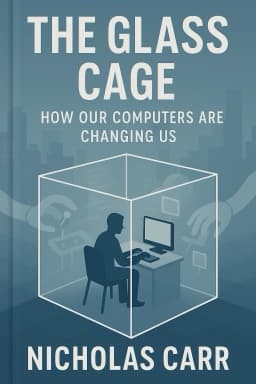
As we set out on this journey through 'The Glass Cage,' let us remember that every advance in automation is both a technical achievement and a human story. The choices we make about how to use machines—what to automate, what to preserve—will shape not just our work, but our very sense of self.
And so, with a sense of wonder and a touch of caution, we step into the next chapter: how automation began to reshape not just our factories, but our minds.